
The fastest air freight option does not always deliver cargo soonest. Air freight services in Kenya vary by service tier, route, and carrier schedule. Transit time depends on how a shipment moves through each stage, not just how long it is in the air.
Speed matters, but so does choosing an option that fits the shipment’s urgency and handling needs. A time-sensitive consignment may need a different service tier from cargo that can travel on a more flexible schedule.
This guide explains how air freight tiers affect transit times, how carrier networks and schedules shape delivery, and what to consider for different industry logistics needs. It also compares air with sea freight, so you can weigh speed against the wider requirements of your shipment and make a more informed choice.
Key Takeaways
- Understand how carrier routes, flight schedules and cargo connections shape delivery timing through Kenya’s air freight network.
- Compare service tiers by urgency and handling needs to choose an option that fits your shipment.
- See how cargo characteristics and industry requirements influence logistics planning.
- Weigh air and sea freight by considering speed alongside the wider needs of your shipment.
- Learn how coordinated cargo and freight support can simplify planning and shipment movement.
Global air freight network and carrier schedules
Kenya connects to global trade through cargo routes, airline schedules, and onward connections. A shipment’s route and available capacity shape how it moves.
Global Route Coverage
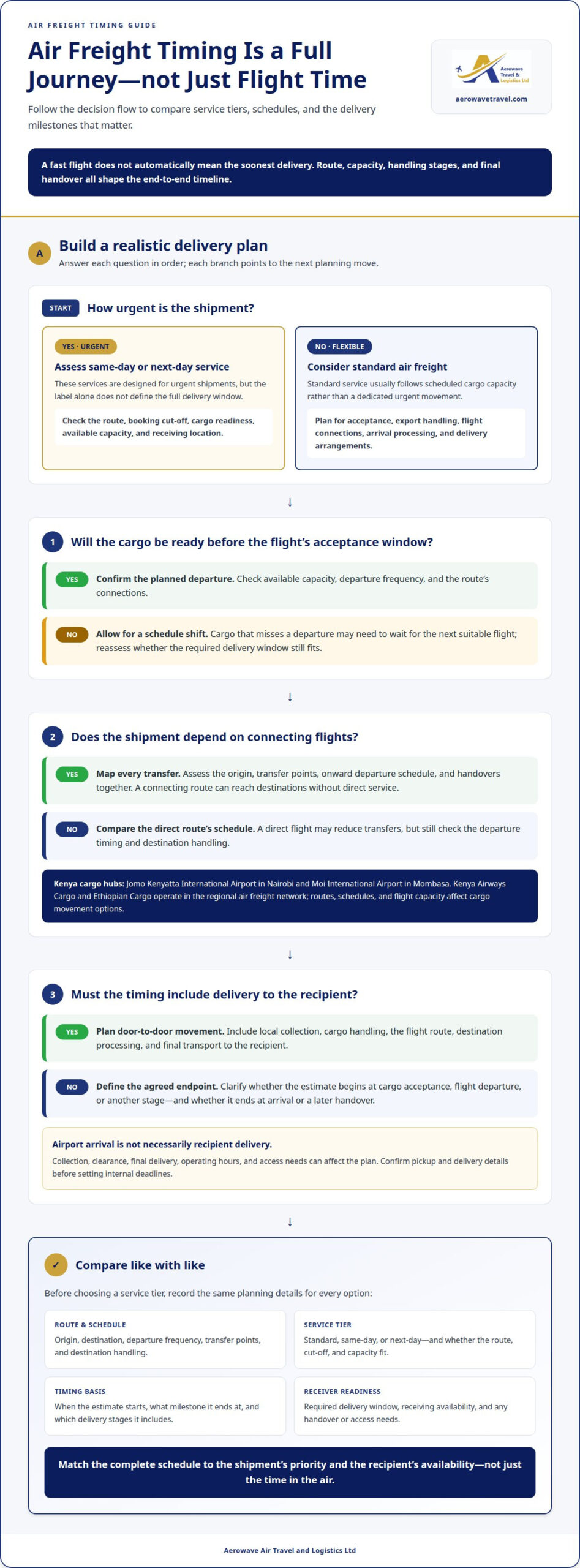
Air freight coverage depends on cargo routes and how connecting flights align. For a shipment from Kenya, assess the origin, destination, transfer points, and schedule together. A direct flight may reduce transfers, while a connecting route can reach destinations without direct service. Include each connection and handover when planning the shipment.
In Kenya, Jomo Kenyatta International Airport in Nairobi and Moi International Airport in Mombasa are key cargo hubs. Kenya Airways Cargo and Ethiopian Cargo operate in the regional air freight network. Their routes and schedules, along with flight capacity, affect cargo movement options. Match the route to the shipment’s destination and timing needs.
Flight schedules affect more than time in the air. If cargo misses a departure, it may have to wait for the next suitable connection. For example, a shipment routed through Nairobi needs coordination between its arrival, transfer, and onward departure.
Air Freight Service Choices in Kenya
Kenyan air cargo options include freight handling, export cargo, and express mail delivery. The right choice depends on urgency, size, handling needs, and destination. Warehousing and distribution can support planning before or after a flight. Compare the service scope, route, and schedule with your supply requirements.
Required shipment documents vary by goods, route, and transaction. Shipment information should identify the cargo, parties, value, packing, and transport details. Customs clearance, duties, and taxes depend on the shipment and applicable requirements, including the goods and destination.
Restrictions depend on the cargo, destination, and carrier acceptance conditions. Do not assume controlled or sensitive goods can travel without specific handling or approvals. Applicable Kenyan requirements and the route determine what can be carried.
There is no single cost per kilogram. The quote depends on the shipment and its route, chargeable weight, service tier, available capacity, and handling needs. Carriers may compare actual weight with volume-based weight under their billing method. Dimensions and applicable surcharges can also affect the quote.
To arrange a shipment from Kenya, provide its origin, destination, cargo description, dimensions, weight, and preferred timing. Choose packaging that protects the goods through transfers and handling. You can also consider insurance in relation to cargo value and transit exposure.
Standard air freight delivery speeds
Delivery time depends on the route, flight schedule, handling stages, and final destination. Compare the full journey to distinguish flight time from end-to-end movement.
Standard Delivery Timing
Standard air freight usually follows scheduled cargo capacity rather than a dedicated urgent movement. The journey includes acceptance, export handling, flight connections, arrival processing, and delivery arrangements. Each stage affects when the cargo can reach its recipient.
For a shipment from Nairobi to an overseas destination, direct and connecting routes have different timelines. Compare departure frequency, transfer points, and destination handling, not just flight duration. Cargo that misses its planned departure may wait for another suitable flight.
Transit estimates describe planned movement along a route, not necessarily a delivery commitment. Clarify the starting point and destination milestone, and whether the estimate begins at cargo acceptance, flight departure, or another agreed stage.
Same-Day and Next-Day Options
Same-day and next-day services are designed for urgent shipments, but the label alone does not define the full delivery window. The route, booking cut-off, cargo readiness, available capacity, and receiving location all affect whether the schedule fits.
For example, cargo ready after a flight’s acceptance window may not travel on that departure. Arrival at an airport the next day does not necessarily mean delivery to the recipient that day. Assess flight arrival separately from collection, clearance, and final handover.
Check which milestones the service covers: collection, airport acceptance, arrival, and delivery. Comparing the same milestones helps teams plan production, inventory, or customer commitments around a realistic schedule. When arranging an urgent shipment, share the latest cargo-ready time and destination requirements.
Door-to-door delivery coordinates movement from the sender’s location to the recipient’s address. It includes collection and final delivery in the transport plan, rather than treating airport-to-airport movement as the whole journey. For a business shipping from Nairobi to a customer abroad, timing includes local collection, cargo handling, the flight route, destination processing, and final transport.
Confirm the pickup location, delivery address, operating hours, and access needs before setting internal deadlines. A tight receiving window may require earlier collection or a different flight connection. Clear handover points also help teams identify where a delay affects the overall plan.
For a useful comparison, record the route, service tier, stated timing basis, and included delivery stages for each option. Then match the schedule to the shipment’s priority and the receiver’s availability. For coordinated air cargo planning, share the cargo details and required delivery window when arranging movement.
Tailored logistics for different industries
Industry needs shape how cargo is prepared, prioritized, and handed over. For a Kenyan exporter serving global markets, a useful logistics plan starts with the goods, destination, deadline, and receiving process.
A horticulture exporter, for example, may prioritize handling instructions and a delivery window that fits the buyer’s schedule. A machinery supplier may focus on dimensions, weight, protective packing, and whether the cargo can travel together. These examples show why the plan should reflect the shipment, not just its industry.
For a Nairobi apparel business sending samples to an overseas buyer, the key may be matching dispatch timing to a product review or production milestone. The plan can specify when samples will be ready, how they are grouped, and who will receive them. Clear details help logistics coordinators align cargo preparation with its commercial purpose.
A manufacturer exporting replacement components may prioritize clear shipment identification and coordination with the customer’s receiving team. For example, the consignment can be planned around the component’s role in a repair or production schedule. The sender should provide dimensions, packing details, handling requirements, and the required arrival window to support suitable routing.
For healthcare-related cargo, communicate the goods’ handling requirements and destination instructions before arranging transport. Specific handling needs should inform the plan throughout the journey. Align the cargo description, packing, route, and receiving arrangements rather than relying on a generic shipment profile.
Across these examples, the same planning sequence helps teams compare industry-specific freight solutions:
- Describe the goods, their dimensions, and any handling requirements.
- Set the destination, required arrival window, and receiving contact.
- Align packing and shipment grouping with the cargo’s intended use.
- Choose a route and service approach that fits the priority and movement needs.
For a Kenyan exporter, these details help distinguish urgent cargo from shipments that can follow a flexible schedule. They also clarify handovers between the sender, freight coordinator, carrier, and recipient. Consistent shipment information at each stage supports a smoother process, especially when different teams manage preparation, transport, and receipt.
Industry is a useful starting point, but the individual consignment should guide the final plan. Textile samples, machine components, and temperature-sensitive goods can have different priorities, even when they travel from the same Kenyan origin. Matching transport to the cargo’s purpose helps businesses coordinate supply needs without treating every shipment alike.
Morgan Cargo Logistics states that about 47% of air-shipped perishables come from countries with a particular temperature context. That figure reinforces the value of recording the cargo’s handling requirements and intended receiving arrangements before selecting a service. Exporters can share relevant shipment details with their logistics coordinator so preparation and handover are considered together.
Treat temperature-related needs as part of the shipment brief, alongside destination, packing, and arrival window. Clear instructions help the parties responsible for the consignment assess whether the proposed arrangements suit its intended journey. Do not assume every perishable shipment needs the same plan.
Air freight versus sea freight
For Kenyan businesses, the choice between air and sea freight depends on urgency, cargo characteristics, and supply chain priorities. Compare movement from origin to recipient rather than choosing by transport mode alone.
Air freight can be useful when timing has significant business value. A Nairobi exporter sending product samples to an overseas buyer, for example, may need them before a review meeting or production decision. Air transport supports faster movement, but the route, handling, and delivery arrangements still shape the overall schedule.
Sea freight is often practical for larger shipments with flexible arrival windows. A business replenishing stock in bulk can plan around longer transport lead times and coordinate inventory accordingly. Consider the complete supply chain: when goods will be ready, how much stock is available, and when the recipient needs it.
Comparing costs requires more than looking at the quoted transport charge. For air cargo, dimensions and chargeable weight can affect the quote. For sea cargo, consider the shipment’s size, space requirements, handling, and associated transport stages. Compare the full quoted scope for each mode, including collection and final delivery where required, rather than unrelated line items.
Consider these factors when selecting a mode for a Kenyan shipment:
- Urgency: Identify the latest useful arrival date and the consequence of missing it.
- Shipment profile: Compare the cargo’s size, weight, value, and handling needs.
- Inventory: Decide whether current stock can cover demand during a longer sea journey.
- Destination: Include inland transport and receiving arrangements in the comparison.
- Flexibility: Consider whether the delivery date or shipment size can be adjusted.
A growing business may use both modes for different supply needs. For example, it could send a small urgent consignment by air while shipping planned replenishment by sea. Separating urgent requirements from routine stock can streamline transport planning without assigning every shipment the same priority.
Before booking, map the shipment’s origin, destination, ready date, required arrival window, and delivery point. Then compare air and sea options against those details. For a time-sensitive Nairobi export, air may fit the deadline better; for planned bulk stock with flexible timing, sea may suit the operating plan. Choose according to the shipment’s purpose and the consequences of delay.
Air freight service tiers and transit times
Service tiers balance urgency, routing, and shipment handling. Compare what each tier includes, then assess the complete journey from Kenya to the destination.
Transit times from Kenya to major destinations depend on route, flight schedule, service tier, and processing at each endpoint. There is no single transit time for every destination. A direct shipment from Nairobi and one using connecting flights have different movement plans, even though both travel by air.
Tier names can vary, so focus on service scope rather than the label alone. An express option prioritizes urgent movement; a standard option follows scheduled capacity; a more flexible option may suit cargo with a wider delivery window. Compare departure timing, connections, handling stages, and final delivery arrangements.
For example, a Kenyan exporter sending documents for a time-sensitive transaction may prioritize an express service. A business replenishing planned stock may choose a standard schedule if its supply plan allows flexibility. A larger consignment without a fixed arrival deadline may suit a flexible forwarding plan. The right fit depends on the consequences of delay for the sender or recipient.
Ask what the quoted transit estimate measures. It may cover airport-to-airport movement rather than collection through final delivery. A door-to-door arrangement includes additional stages, such as origin collection and delivery at the destination. Record the start point and expected handover point before comparing options.
Use these steps to compare two service tiers for the same shipment:
- Set the latest useful arrival date and identify the consequence of missing it.
- Compare scheduled departures, connections, and the shipment’s cargo-ready time.
- List which handling and delivery stages each option includes.
- Match the tier to cargo characteristics, recipient availability, and the required destination.
Capacity and flight frequency affect which tier suits a route. Cargo that reaches the airport after its planned departure may move on a later flight, and connections can add waiting time. Include these stages in operational planning rather than treating flight duration as the full delivery estimate.
For a clear comparison, provide the origin, destination, cargo details, ready date, and required arrival window. Then assess each proposed schedule against the shipment’s purpose. If you’re arranging a shipment from Kenya, coordinate your air cargo booking around its priority and delivery requirements.
Freight forwarding services in Kenya coordinate the transportation of goods, manage documentation, and navigate customs procedures. These responsibilities can sit alongside the flight schedule, so clarify which parts of the movement the quoted tier covers. Ask whether the forwarding arrangement coordinates the shipment only between airports or also covers collection and final delivery, consistent with the handover points you are comparing. Confirm how documentation and customs procedures are managed for the chosen service, and whether any required information must be ready before cargo is accepted. This helps distinguish an estimate for air movement from a broader transport plan. Keep the same shipment details and arrival requirement when requesting alternatives, then compare the stated scope as well as the expected timing. That makes the choice easier to assess against the urgency and flexibility already identified.
Aerowave Air Travel and Logistics: Air Cargo and Freight Services
Aerowave Air Travel and Logistics Ltd provides reliable air freight services for businesses coordinating shipments from Kenya. Utilize these professional air freight services when planning cargo movement around its destination, urgency, dimensions, and handling requirements.
Share the cargo description, origin, destination, ready date, and preferred arrival window. These details help shape a practical freight plan and clarify the stages involved in moving your shipment through expert air freight services. For export cargo, coordinated planning can also align transport arrangements with your business’s supply needs.
If your shipment is part of a wider travel plan, Air Ticketing Services, Flight Booking Services, and Airport Transfers Services can support related arrangements alongside your chosen air freight services.
Contact Aerowave Air Travel and Logistics Ltd today to discuss your cargo movement requirements and discover tailored air freight services.
Make your next shipment decision with confidence
Turn delivery priorities into a clear internal shipping plan. Decide who approves urgent transport, shares cargo information, and updates the receiving team when plans change. This gives procurement, operations, and customer teams a common process instead of treating each shipment as an exception.
As your business grows, review the process when product mix, destination markets, or customer expectations change. The right air freight approach should support how your organisation works, not create uncertainty for people relying on each delivery. A clear decision path also helps teams respond calmly when an order needs a different transport arrangement.
Aerowave Air Travel and Logistics Ltd can support your cargo planning alongside related travel needs. Contact Aerowave Air Travel and Logistics Ltd to discuss the next step for your shipment. With a shared plan in place, your team can move forward with greater clarity and focus.
Frequently Asked Questions
How do air freight, sea freight, and courier services compare in cost and delivery time?
Air freight generally prioritizes speed, sea freight suits flexible schedules, and courier services are commonly used for smaller parcels and documents. Costs depend on weight, dimensions, route, handling, and delivery scope, so compare quotes for the same cargo and origin-to-destination service. For example, a Kenyan business sending an urgent document may consider courier delivery, while planned bulk stock could suit sea transport.
How much does air freight cost per kg in Kenya?
There is no single cost per kilogram. A quote depends on the shipment’s route, chargeable weight, service tier, available capacity, and handling needs.
How are air freight charges calculated, including volumetric weight and surcharges?
Carriers may compare actual weight with volume-based weight under their billing method. Dimensions and applicable surcharges can also affect the quote.