The right safari timing depends on what your group wants to see and when everyone can travel. Migration months, school holidays, festive dates, specialist rooms and large room blocks call for earlier planning, while a focused Masai Mara trip with Nairobi can fit into 5 to 6 nights.
Planning group travel in Kenya means balancing those dates with the route, shared interests and the pace of the trip. A classic Kenya safari circuit can suit groups with seven to ten days, while adding Amboseli and Lake Nakuru creates a longer itinerary of 8 to 10 nights. The best option is the one that gives your group time in the parks it values most without making travel days feel rushed.
This guide explains how to choose travel dates, compare safari routes that include Kenya’s key parks, and understand what affects per-person package costs. It also covers how group size, vehicles, accommodation and arrival arrangements shape the plan, helping you make informed decisions about the trip.
Key Takeaways
- Choose a safari route around your group’s shared interests, then allow enough time for park visits and transfers.
- Compare focused Kenya itineraries with longer combinations that include Tanzania to find the right pace for your group.
- Plan vehicle arrangements and group coordination around comfort, luggage and the way travellers want to experience each drive.
- Understand how accommodation, route, travel dates and group requirements shape the per-person package cost.
- Use professional event travel planning to coordinate flights and airport transfers alongside the safari itinerary.
What is the best time to visit Kenya for a safari?
The best time for a Kenya safari depends on your group’s priorities and available dates. Plan ahead for migration months, school holidays and festive periods, especially if you need specialist rooms or a large room block. These dates can affect accommodation options and how easily everyone can travel together. A clear date window helps the organiser compare routes before coordinating flights and park stays.
Allow time for transfers as well as wildlife viewing. A route that adds Amboseli and Lake Nakuru lasts 8 to 10 nights, and two or three nights in major parks helps avoid frequent packing and moving. A focused route covering one or two ecosystems can suit families and first-time safari travellers. For complicated arrivals, a Nairobi staging night gives the group time to assemble before travelling onward.
Group travel planning in Kenya starts with choosing a pace that suits everyone. Identify two or three shared safari priorities, such as wildlife viewing, photography or particular parks. Then build the route around them rather than adding stops without enough time to enjoy each one. Keep one up-to-date itinerary and rooming list so the organiser and backup can work from the same details.
What safety risks should groups consider when travelling in Kenya? Road fatigue, separated travellers and getting too close to wildlife can complicate a group safari. Set meeting times, follow the guide’s instructions during drives, and agree how the organiser will account for everyone at stops and during transfers.
What local customs, tipping practices and payment options should groups know in Kenya? Customs and gratuity expectations can vary, so ask the safari guide to explain local etiquette and agree how tips will be handled. Before travelling, record accepted payment methods and shared expenses in the group itinerary.
For group decisions, appoint a lead organiser and a backup. Set internal deadlines ahead of supplier deadlines, and arrange bookings early for peak dates or large room blocks. A group of twelve safari travellers needs several vehicles and a coordination plan. Four people per vehicle can offer more room for photography; five or six may fit, depending on vehicle space, luggage and comfort expectations.
Groups also benefit from agreeing on seating, bathroom expectations and meeting times before the first drive. These details matter for incentive trips, where the schedule may need to balance shared activities with individual preferences. Make arrival arrangements, park transfers, accommodation and planned activities clear in the itinerary, so participants know when they will travel together.
When choosing a safari organiser, focus on how they coordinate the moving parts: itinerary updates, rooming details, vehicle arrangements and arrivals. Ask for one shared version of the plan and a clear way to communicate changes. Whether your group prefers a focused wildlife route or a longer park circuit, a well-paced schedule makes each transfer part of the trip rather than a disruption.
Kenya small-group tour options
Kenya’s small-group safari options range from a focused Masai Mara stay to a longer regional circuit. The right fit depends on how much time participants have, which parks matter most and whether the itinerary stays within Kenya. For group travel planning in Kenya, compare the total trip length with its pace, not just the number of destinations. A route that looks broad on paper may leave little time at each stop.
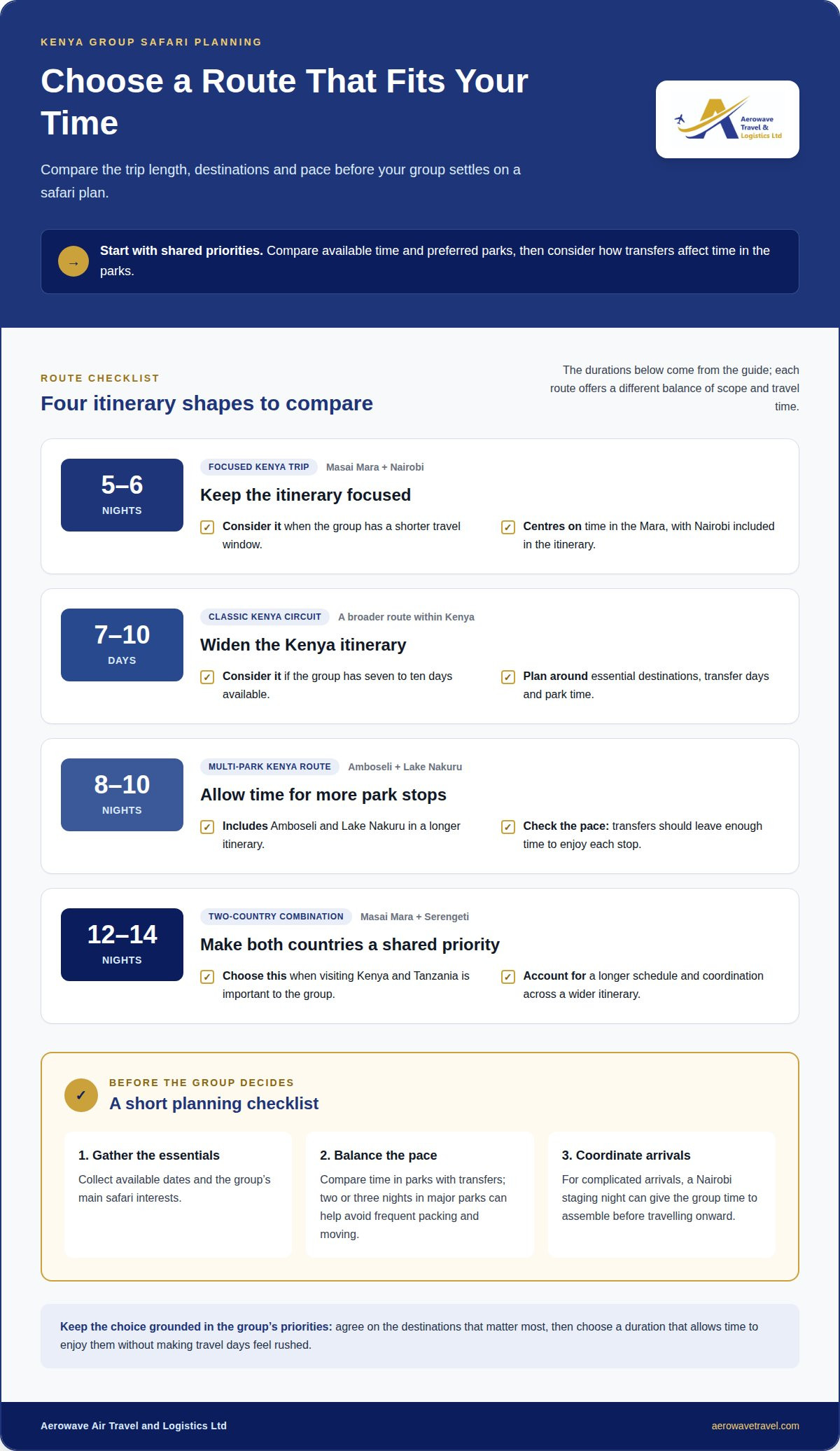
A focused Masai Mara safari with Nairobi included lasts 5 to 6 nights. This option suits groups with a shorter travel window or a clear priority: time in the Mara, with Nairobi as part of the itinerary. The organiser can use the fixed duration to coordinate arrival and departure plans, then brief participants on what the schedule includes. It’s a more contained choice than combining countries or adding multiple park regions.
Groups with seven to ten days can consider the classic Kenya safari circuit. It offers a wider choice of routes while keeping the trip within Kenya. First identify essential destinations, then assess how each stop affects transfer days and time in the parks. For example, a group seeking a varied Kenya itinerary can compare the classic circuit with a Mara-focused plan before agreeing on shared priorities.
A Kenya and Tanzania combination covering the Mara and Serengeti lasts 12 to 14 nights. It is the longer option, so it calls for coordination across a wider itinerary and more participant communication. The group should agree that visiting both countries is a shared priority, rather than adding Tanzania simply to increase the number of destinations. The extra duration can also affect how members plan annual leave, arrival dates and the overall trip schedule.
Use a simple comparison when reviewing options:
- 5 to 6 nights: Masai Mara and Nairobi, for a focused Kenya trip.
- Seven to ten days: the classic Kenya circuit, for a broader in-country route.
- 12 to 14 nights: the Mara and Serengeti, for a Kenya and Tanzania combination.
Before choosing an itinerary, the organiser can collect each participant’s available dates and main interests. Compare the options with those shared requirements, including the balance between park time and transfers. A family group may prefer a shorter route with fewer transitions, while a group keen to visit the Mara and Serengeti may value the extended combination. These examples help clarify the choice without assuming everyone wants the same pace.
Keep one itinerary version for the group, with the route, trip duration and arrival plan easy to understand. A clear summary helps participants make informed decisions and gives the organiser a consistent basis for coordinating travel. Matching the route to the group’s available time and priorities makes it easier to choose between a focused safari, a Kenya circuit and a regional combination.
Masai Mara, Amboseli and Lake Nakuru
Combining the Masai Mara, Amboseli and Lake Nakuru gives a group three named park stops to coordinate. The itinerary adding Amboseli and Lake Nakuru lasts 8 to 10 nights. That duration matters because every additional stop needs to fit alongside transfers, accommodation changes and time in each park. The group’s shared interests should determine whether visiting all three is more valuable than a slower itinerary with fewer stops.
Make the Masai Mara the group’s main focus, or include it as part of a wider circuit. A focused stay keeps more of the schedule centred on one destination. Adding Amboseli and Lake Nakuru changes the balance, so map each park stay and transfer day before settling the plan. Give every stop a clear purpose rather than making the itinerary a sequence of arrivals and departures.
A group route also needs to work in practice. The organiser should collect arrival details, rooming needs and mobility considerations, then align them with the itinerary. Keep one shared schedule that includes departure times, park stays and accommodation changes. If participants have different expectations, such as time for photography and a wider selection of stops, agree which priorities lead before fixing the route.
The Masai Mara offers an activity to consider alongside game drives: the hot-air balloon flight described for the area lasts about an hour. Treat it as optional, not a requirement for every traveller. The organiser can make space for those who choose the flight while keeping the rest of the group’s plans clear. This is useful when participants have different interests or preferred activity levels.
- Masai Mara: decide whether it is the central focus or one stop in a multi-park itinerary.
- Amboseli: include it when the group values adding another named park to the route.
- Lake Nakuru: consider it as part of the longer itinerary, with enough schedule space for the stop.
Before confirming the three-park combination, compare its schedule with a more focused option. Check how many accommodation changes it involves, whether the transfer pattern suits the group, and how much time remains for each park. These practical details help show whether the itinerary is a better fit than a shorter list of destinations.
For group travel planning in Kenya, a clear route summary helps participants understand the trade-off between visiting all three parks and spending longer in fewer places. Set out the park sequence, accommodation changes and optional activities in one itinerary. This gives the group a practical basis for deciding on the Masai Mara, Amboseli and Lake Nakuru combination.
Per-person package prices
A safari package’s per-person price depends on the itinerary and what it includes. Compare the same trip components before weighing one option against another. For example, a Masai Mara itinerary differs from a route that adds Amboseli and Lake Nakuru in duration, park stays and transfers. Those details shape the package total and how it is divided among travellers.
The price depends on the itinerary and is provided after a quote request. Key cost factors include travel dates, route, accommodation, group size, transport and included activities. A longer itinerary has more nights and route components to cost. Accommodation choices affect the total, while group size can influence shared transport and room arrangements. Consider the per-person figure as part of the full itinerary, not as a standalone measure of value.
For a useful comparison, ask for each package itinerary to set out what is included. Review the following items together:
- Accommodation: compare the planned stays and room arrangements for the group.
- Transport: note how transfers between Nairobi and the safari route are handled.
- Activities: identify included experiences, such as game drives or a Masai Mara balloon flight.
- Trip length: compare the number of nights and the time allocated to each destination.
Then work out each traveller’s expected share from the package total and confirmed group size. A rooming list connects the quote to actual arrangements, especially when participants have different sharing preferences. Keep optional activities separate from the main itinerary so travellers can see which choices affect their individual total. This makes budget discussions clearer without assuming everyone wants the same additions.
Travel dates can affect the options available to a group. Plan ahead for migration months, school holidays and festive periods, particularly if you need specialist rooms or a large room block. An early, settled itinerary gives the organiser a clearer basis for comparing accommodation and routes. It also avoids comparing a proposal for peak dates with one based on different travel dates.
The lowest per-person figure may not be the best fit for the group. A shorter route may have fewer cost components but offer less time at destinations participants value. A longer itinerary may add nights and transfers while providing a broader safari experience. Compare what the group receives, the pace of travel and shared priorities before deciding.
During group travel planning, keep one current itinerary and rooming list alongside the package comparison. Record the route, dates, accommodation and included activities in the same version. This helps the organiser explain how the quoted per-person amount relates to the trip and lets participants decide using consistent details. For travellers considering a safari alongside a coastal stay, leisure travel packages in Kenya combining safari and beach stays offer useful context for comparing itinerary duration and cost.
Kenya Group Safaris vs Private Group Trips
A safari package shared with other travellers follows a common itinerary, while a private group trip is arranged for one party. This affects how much control your group has over dates, pace and daily choices. For example, a group happy to follow a set Masai Mara schedule may prefer a shared tour. A family celebrating together may want decisions centred on its own needs.
With a shared tour, the itinerary and departure arrangements are generally set for the travelling group as a whole. This can simplify decisions for people with similar interests and dates, but may leave less room to change the route around one participant’s preference. Before choosing, compare the schedule with your group’s arrival plans, preferred time in the parks and comfort with travelling alongside people outside the party.
A private group trip gives the organiser more scope to coordinate the party’s priorities. The group can discuss spending longer in the Masai Mara, including Amboseli or adding time in Nairobi. That flexibility also requires decisions about which activities matter most and how to handle schedule changes. It suits parties who want a shared experience shaped around their own travel goals.
Use these questions to clarify the difference:
- Who travels together? A shared tour brings together travellers beyond your party; a private trip centres on your own group.
- How fixed is the schedule? A shared itinerary follows its established plan; a private arrangement can reflect group priorities.
- How are decisions made? Shared tours use a common schedule; private trips require the group to agree on route and pace.
Group size also affects practical arrangements. A private party of twelve safari travellers needs several vehicles and a coordination plan. In either format, vehicle capacity, luggage and comfort expectations affect how participants travel. Agree on seating and meeting arrangements before the first drive, so the organiser can share a consistent plan with everyone.
Consider a party with different interests. Some participants may want time for photography, while others prefer to visit more destinations. A shared tour works best when the group accepts its common itinerary. A private trip can make it easier to negotiate preferences, but the organiser needs to gather them and set priorities before finalising the route. Both formats depend on clear communication.
Choose the option that matches your group’s decision-making style, not just its destination list. Compare the route, schedule, accommodation arrangements and how changes are handled. If coordinating arrival details alongside a group itinerary is part of your planning, organize your group’s travel arrangements with a clear plan for each traveller.
Aerowave Air Travel and Logistics Ltd: Event Travel Planning
Aerowave Air Travel and Logistics Ltd coordinates event travel when a safari group also needs organised arrival and departure arrangements. Event Travel Planning brings the schedule into one coordinated plan, while Flight Booking Services and Air Ticketing Services support participants’ flights. Airport Transfers Services help arrange journeys between the airport and the group’s meeting point.
This support is useful when participants arrive on different flights, need a shared itinerary or are travelling to Kenya for an event alongside a safari. Share the group’s travel dates, flight details and transfer requirements so arrangements can align with the event schedule and safari itinerary.
Contact Aerowave Air Travel and Logistics Ltd to discuss your group’s event travel arrangements.
Set Your Group’s Travel Plan in Motion
Turn your group’s priorities into a coordinated travel plan, with flights and airport transfers aligned to the event schedule. Clear information about travellers and arrival plans helps keep decisions organised as arrangements take shape. For group travel planning in Kenya, Aerowave Air Travel and Logistics Ltd can support the journey with Air Ticketing Services, Flight Booking Services and Airport Transfers Services.
Whether you’re coordinating a safari alongside an event or arranging travel for a group gathering, a clear plan gives participants a shared point of reference. Aerowave Air Travel and Logistics Ltd can coordinate travel arrangements around your group’s needs.
Contact Aerowave Air Travel and Logistics Ltd to discuss your group’s travel plans and take the next step with confidence.
Frequently Asked Questions
What are the best destinations in Kenya for group travel?
The best destinations depend on whether the group prioritises wildlife, city experiences or coastal time. The Masai Mara, Amboseli and Lake Nakuru suit groups focused on safari parks, while Nairobi can serve as an arrival point or city stop. Mombasa offers a coastal option after a safari. For groups with mixed interests, choose destinations that match the shared purpose of the trip and allow manageable transitions.
What is the best time of year for group travel in Kenya?
The best travel period is the one that fits the group’s priorities and calendar. Migration months, school holidays and festive dates are popular planning windows, so arrange dates and accommodation early. If participants have limited flexibility, build the itinerary around their shared availability first. If wildlife viewing is the main aim, prioritise the desired safari experience, then coordinate dates and park stays around it.
How much does a group safari in Kenya cost per person?
Per-person safari costs depend on the route, travel dates, accommodation, transport, group size and included activities. A longer itinerary with more destinations has different cost components from a focused stay. For a useful comparison, consider what each package includes and how room arrangements affect the total. Request an itinerary-based quote in Kenyan shillings, then compare the included services rather than relying only on the headline amount.
What are the costs of group transport, accommodation, meals, and park fees in Kenya?
Costs vary with the route, accommodation, meal arrangements, transport plan and parks included. Ask for each component to be itemised in the proposed group itinerary, so participants can distinguish shared costs from personal choices. For example, optional meals or activities should be separate from the core arrangement. Travel dates and rooming preferences also affect accommodation planning and the overall budget.
How can a travel provider plan a group itinerary for Kenya, including Nairobi, safaris, and the coast?
A travel provider can coordinate the itinerary by aligning arrivals, time in the city, safari transfers and coastal travel with the group’s dates and priorities. For example, Nairobi can serve as the meeting point before a safari, with Mombasa considered for a coastal extension. A shared schedule should show travel days, accommodation changes and participant flight details. Aerowave Air Travel and Logistics Ltd can arrange flight bookings and airport transfers.
What are Kenya’s entry, visa, and health requirements for group travelers?
Entry and health preparations depend on each traveller’s circumstances, including nationality, itinerary and travel history. Collect participant details early and organise the required travel documents and health preparations before departure. Aerowave Air Travel and Logistics Ltd offers Visa Consultancy Services to guide travellers through application requirements and document preparation; it does not issue visas. For health-related decisions, travellers should seek guidance suited to their circumstances.
How can a travel provider book group accommodation, safari vehicles, and park permits in Kenya?
These arrangements need a coordinated itinerary that connects rooming needs, transport plans and park visits. A safari operator can manage accommodation, safari vehicles and park-side arrangements, while the travel schedule aligns arrivals and transfers. Share the group’s rooming information, dates and route preferences in one plan to support coordination. Aerowave Air Travel and Logistics Ltd can arrange flight bookings and airport transfers for the group’s journey.