A smooth itinerary is only part of executive travel. Knowing how to choose an executive travel management partner in Kenya means looking beyond flight bookings: assess how thoroughly they coordinate each trip, respond when plans change, protect private information, and adapt arrangements to the executive’s priorities. The right fit is a partner whose planning and communication give your team confidence before and during travel.
Reliable bookings matter, but so does knowing how disruptions will be handled and who will keep the details aligned. This guide explains how to assess travel planning, support, trust, and personal preferences, then match those services to your organisation’s needs. You’ll have a clearer basis for how to choose an executive travel management partner in Kenya and keep executives focused on work.
Key Takeaways
- Assess whether travel planning coordinates flights, accommodation, ground transport, and the trip’s purpose into one workable itinerary.
- Clarify how schedule changes and travel disruptions are managed, including who communicates updates and what support is available.
- Look for discreet handling of executive information and clear communication that helps build trust over time.
- Account for the executive’s preferences, schedule, and personal priorities so arrangements protect valuable time and reduce last-minute surprises.
- Choose services that fit your organisation’s travel needs, from corporate travel management and flight bookings to airport transfers.
1. Holistic planning for flights, hotels, and ground transport
A complete executive itinerary connects flights, accommodation, ground transport, and meeting schedules. Each choice should suit the trip’s purpose, destination, timing, and travellers. For example, a Nairobi meeting that ends late calls for a suitable transfer and accommodation plan. Booking a flight separately can leave a gap in those arrangements. Effective planning aligns each part before the executive departs.
Start with the business purpose and expected schedule. Then consider the destination, other travellers, and individual preferences. A senior leader travelling alone may need a different plan from a delegation attending meetings in several locations. Hotel proximity, arrival time, and transfers can affect the time available for work. These details shape a practical itinerary, rather than simply filling a booking request.
Compare flight, accommodation, and ground transport costs against the same itinerary and service requirements. Review the full quoted total and what each component includes, then weigh convenience and schedule fit alongside cost. A lower fare may not suit a trip if its timing disrupts meetings or creates difficult connections.
For Kenyan corporate travel, tax treatment and invoice requirements depend on the transaction and the company’s accounting needs. Planning should also account for applicable data protection and destination-specific travel requirements, without assuming one rule applies to every itinerary. Clear invoices and careful handling of traveller details support orderly administration.
Travel management fees and pricing models vary with service scope, itinerary complexity, and booking volume. Quotes may use per-booking charges, management fees, or a combination. Compare proposals using the same trip details and included services. The price depends on the case, with factors such as trip complexity and service scope shaping the cost.
In Nairobi, corporate travel providers can coordinate itineraries and related bookings. Compare proposals against one consistent trip brief, covering flights, accommodation, transfers, group needs, and the expected coordination process. This helps you judge whether a provider’s planning approach suits your organisation’s actual travel pattern.
Strategic planning also applies to team-building activities. A company outing may combine a planning session, shared transport, meals, and an activity, so timing and group needs matter. The planner should understand the team’s objectives before arranging the day. A de-stressing activity, for example, calls for a different schedule from a focused strategy session.
MICE travel, meaning meetings, incentives, conferences, and exhibitions, adds group coordination. Attendees may arrive on different flights, need shared transfers, or follow separate schedules after an event. A useful plan connects arrival windows, accommodation, venue timings, and onward transport. For a conference group, one missed connection can disrupt several people’s plans.
Look for joined-up expertise across the full itinerary. The planning process should account for schedule changes, practical connections, and executive priorities. This helps you assess whether a partner can coordinate a business trip or group event as one coherent plan.
2. Around-the-clock emergency support
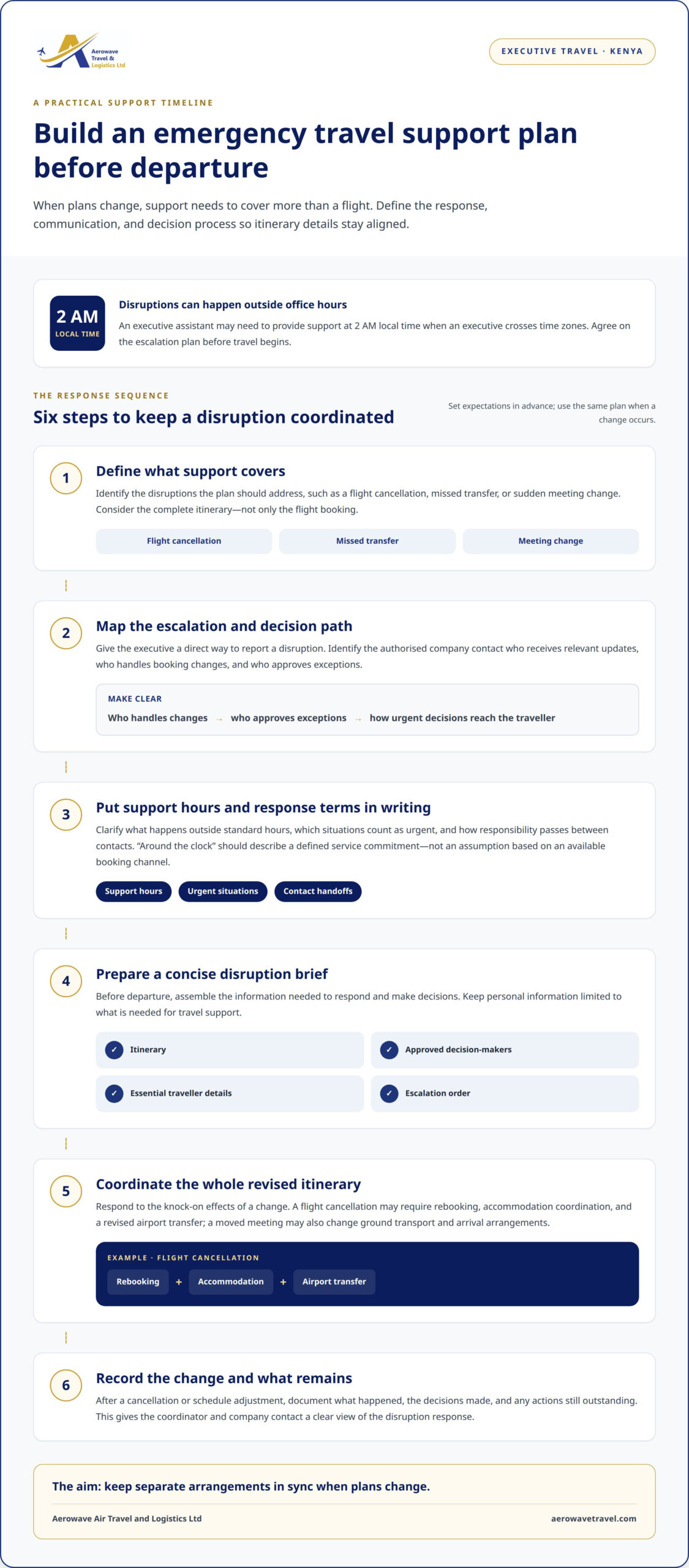
Travel disruptions rarely follow an office schedule. A delayed connection, missed transfer, or sudden meeting change can affect leaders after normal business hours. An executive assistant may need to provide support at 2 AM local time when an executive crosses time zones. That makes a clear escalation plan essential, even when the disruption seems manageable at first.
Define what emergency support covers before travel begins. A flight cancellation, for example, may require rebooking, accommodation coordination, and a revised airport transfer. If a meeting moves forward, ground transport and arrival arrangements may need to change too. The response should address the whole disruption, not just the flight. This keeps separate arrangements in sync.
Agree on how urgent changes will be communicated. The executive needs a direct way to report a disruption, while an authorised company contact should receive relevant updates. A practical escalation plan identifies who handles booking changes, who approves exceptions, and how urgent decisions reach the traveller. Keep the instructions concise enough to use during a stressful airport delay.
Clarify support hours and the response process in writing. “Around the clock” should describe a defined service commitment, not an assumption based on a booking channel being available. Establish what happens outside standard hours, which situations count as urgent, and how responsibility passes between contacts. Clear terms help your organisation assess support realistically.
Regional travel can become more complex when a change affects several legs or travellers. A leader travelling from Nairobi to another regional business centre, for instance, may miss a connection and have the onward schedule disrupted. A coordinated response considers the revised itinerary, accommodation, ground transport, and meeting commitments together. This approach can protect business time better than managing each booking separately.
Before departure, the travel coordinator can prepare a concise disruption brief with the itinerary, approved decision-makers, essential traveller details, and escalation order. Limit personal information to what is needed for travel support. The executive should know whom to contact, while colleagues should understand when they need to act.
Support also means recording what changed and why. After a cancellation or schedule adjustment, the coordinator can document the issue, decisions made, and remaining actions. This creates a useful record for expense processing and future planning. If a route repeatedly creates tight connections, that pattern can inform later itinerary choices.
For a competitive organisation, reliable emergency planning is more than a promise of immediate assistance. It is a defined process that assigns responsibility, communicates changes, and keeps the whole trip aligned. Include these expectations when assessing executive travel support in Kenya.
3. Building trust as a strategic travel partner
Trust is tested through everyday decisions, not polished promises. In Nairobi, a booking change may affect an executive’s privacy, schedule, and business commitments. A dependable partner explains who can access traveller details and how updates are shared. It should send itinerary changes to authorised company contacts without exposing unnecessary personal information. Clear boundaries show leaders what the partner handles and what requires approval.
For accreditation, licences, insurance, and references, request relevant documents and verify details with the issuing organisations. Review insurance coverage and exclusions, then speak with business references about communication, booking accuracy, and how challenges were handled. These checks help distinguish documented capability from general claims. Consider documents and references alongside the proposed process, not as proof of every aspect of service quality.
Technology should make travel activity easier to understand and manage. Useful features can include a central itinerary, approval records, booking details, and change notifications. Reporting should help a business review travel dates, destinations, spending categories, and exceptions against its own policy. A finance team, for example, may need clear booking and change records for expense reconciliation. Access to traveller information should also reflect the organisation’s needs.
An unsuitable partner can create practical risks. A missed booking update may leave an executive with outdated departure details, while disconnected reservations can complicate hotel arrival or transfers. Poor handling of private information can undermine confidence, and unclear approval steps can lead to bookings that do not match company priorities. Ask how the proposed process handles a flight change, late arrival, or confidential itinerary before relying on it.
Trust also depends on consistent communication. Agree on authorised contacts, approval routes, and update formats before the first trip. If a leader’s Nairobi meeting moves, the travel coordinator should know who approves changes and how the revised itinerary is recorded. A short written procedure prevents uncertainty when several colleagues support one traveller. It also gives the business a practical basis for reviewing service quality after each trip.
A strategic partner learns the organisation’s travel patterns and responds with appropriate discretion. The provider should explain its booking workflow, reporting approach, and information-handling practices in plain language. Compare those answers against a realistic example, such as a schedule change affecting two executives. Specific explanations make trust easier to assess than broad assurances, while documented processes support accountability as travel needs evolve.
4. Protecting executive time and personal priorities
Start with the executive’s travel preferences, communication style, and priorities. One leader may prefer early departures, while another values uninterrupted work time before meetings. The travel coordinator uses these details to shape suitable arrangements. This context helps the partner make consistent decisions across bookings, rather than treating each trip as an isolated request.
Build the itinerary around the purpose of travel and the executive’s schedule. For a Nairobi meeting, allow practical time for arrival, preparation, and onward commitments. The coordinator should note preferred travel times, any dietary or accessibility needs shared for the trip, and communication preferences. These details can make the difference between a workable schedule and one that adds avoidable pressure.
Confirm trip details before finalising arrangements. Ask whether the executive is bringing a guest or needs an additional stop, since either can change transport and timing. For example, a hotel transfer may need adjustment if a guest joins the itinerary. Clear confirmation gives the coordinator the full picture and reduces last-minute surprises.
Protecting time also means distinguishing essential commitments from optional activities. An executive attending a conference may need quiet time before a presentation, while another may prioritise networking after sessions. The planner can use these priorities to organise the day. An exclusive dinner or separate meeting should fit the itinerary, not compete with its central purpose.
A strong working relationship depends on clear, respectful communication. Agree how the executive prefers to receive itinerary updates, such as through an authorised assistant or another chosen channel. If a change arises at 2 AM local time during travel across time zones, the contact plan should make responsibilities clear. That way, an update reaches the right person without unnecessary messages.
After each trip, collect focused feedback from the executive. Ask what went wrong, what worked well, and what they would prefer next time. If transfer timing caused a rushed arrival, record that preference for future planning. This review turns individual experience into useful context and helps tailor the travel relationship over time.
Personal priorities can also shape an executive outing. A team may value strategic planning, team-building, networking, or time to de-stress. The organiser should first establish the desired outcome, then match the schedule and activities to it. A day designed for strategic discussion needs a different rhythm from one intended to help colleagues connect informally.
Establish the purpose of an outing before choosing activities. Executive day-trip activities can include strategic planning, team-building, networking, and de-stressing. Consider which option best fits the intended outcome and the executive’s priorities, rather than assuming every activity belongs in the plan.
Before arranging support, executive assistants should learn an executive’s travel and communication preferences, priorities, and expectations. Confirm details in advance, including whether the executive is bringing a guest or needs an additional stop, so arrangements can account for them. After each trip, ask what went wrong, what the executive liked, and what they would prefer next time. Record that feedback so future planning reflects the executive’s experience and preferences.
5. What services should an executive travel management partner in Kenya provide?
A partner should coordinate the moving parts of business travel, not simply process isolated bookings. For a Nairobi meeting, that means aligning flight arrangements with the executive’s schedule and stated requirements. The itinerary should reflect the trip’s purpose and traveller preferences, guided by the organisation’s priorities. This joined-up service helps teams assess how each arrangement supports the wider journey.
Booking support should cover itinerary planning, reservations, and adjustments when business plans change. If a meeting moves, the coordinator can identify which arrangements need updating and communicate revised details. The goal is to keep the journey coherent, rather than leaving the executive to resolve disconnected bookings. Clear approval steps also ensure changes align with company priorities.
For executive groups, the service should support discretion and efficient coordination. Consider a leadership team travelling to the same event on different flights. The planner can coordinate arrival information and relevant schedule details while respecting each traveller’s privacy. Group support should reflect the event’s actual requirements, rather than treating every traveller as part of an identical itinerary.
Trip monitoring and adjustment matter too. A partner should follow travel progress, respond to schedule changes, and keep appropriate contacts informed. If a delay affects a transfer, the coordinator can assess the impact and communicate next steps. After travel, feedback helps identify what worked and what the organisation may want handled differently on future trips.
Organisations may also need support for events and group travel. A conference itinerary can involve varied arrival times, venue commitments, and onward journeys. Planning should connect those details with the event schedule and traveller needs. For a smaller executive delegation, priorities may instead include privacy, flexibility, and minimal disruption between appointments.
Before engaging a partner, define the scope your organisation expects. Clarify which arrangements are coordinated, how approvals work, what updates are provided, and how feedback is captured. A sample scenario, such as a delayed flight before a scheduled meeting, can reveal whether the proposed process meets your organisation’s needs. These criteria help explain how to choose an executive travel management partner in Kenya.
If you are still considering how to choose an executive travel management partner in Kenya, assess whether the service scope fits individual trips, recurring business travel, or event groups. A professional partner can coordinate relevant arrangements around your organisation’s priorities and executives’ requirements.
Executive assistants should monitor trips, adjust arrangements when schedules change, and collect feedback after travel to improve future experiences. This gives the organisation a practical basis for refining its approach to future journeys.
Aerowave Air Travel and Logistics Ltd: Corporate Travel Management
Aerowave Air Travel and Logistics Ltd supports Kenyan organisations that need coordinated business travel. Its Corporate Travel Management service brings flight arrangements and trip planning together around executives’ schedules and priorities. Air Ticketing Services and Flight Booking Services help organise air travel, while Airport Transfers Services support ground transportation.
This is a practical next step when your team needs professional coordination for executive journeys, recurring business travel, or company events. Share the trip purpose, itinerary needs, and traveller preferences so arrangements can be shaped around your organisation’s requirements.
Contact Aerowave Air Travel and Logistics Ltd to discuss corporate travel planning for your team.
Set your next business trip up for success
Turn your organisation’s travel priorities into a clear working brief. Identify the trip’s purpose, decision-makers, preferred communication, and arrangements that need coordination. This gives a prospective partner a practical basis for planning and helps your team assess whether its approach fits your needs.
Use these criteria to decide how to choose an executive travel management partner in Kenya that supports business requirements and executive preferences. Aerowave Air Travel and Logistics Ltd offers Air Ticketing Services, Flight Booking Services, and Airport Transfers Services to coordinate key parts of a business journey.
When you’re ready to discuss your organisation’s travel arrangements, contact Aerowave Air Travel and Logistics Ltd. A clear brief is a useful starting point for a more organised approach to executive travel.
Frequently Asked Questions
How to evaluate corporate travel agencies in Kenya for executive travel?
Evaluate each agency against your organisation’s real travel needs, not broad claims. Request a sample itinerary for a Nairobi business trip, showing how it coordinates flight bookings, accommodation, and airport transfers. Review its communication and approval processes, privacy practices, and reporting format. References can help you understand how the agency handled past booking changes and whether its service met client expectations.
How do Kenyan travel management partners handle 24/7 support and travel emergencies?
Emergency support depends on the provider’s stated service hours and escalation process, so ask what assistance is available outside normal business hours. Use a sample disruption, such as a delayed arrival in Mombasa, to clarify who receives the alert, who can approve changes, and how revised arrangements are communicated. Ask whether the support covers the full itinerary or only flight bookings, and have the agreed process documented.
What questions should a company ask when requesting proposals from Kenyan travel management providers?
Give each provider the same travel brief, then ask how its proposal addresses your routes, traveller preferences, approval process, reporting needs, and schedule changes. Request a clear breakdown of included services and any applicable management or booking charges, without assuming pricing models are identical. Also ask how traveller information is handled and what records your finance team receives. A consistent brief makes proposals easier to assess fairly.