
Good freight planning involves more than choosing a route. Cargo handling services can support business shipments with loading and unloading, packing and unpacking, and moving goods into or out of storage and transport containers. Depending on the cargo, handling may also require equipment such as forklifts or cranes.
It’s understandable to want clear oversight while a shipment is moving. Tracking and automation can make shipment milestones and handovers easier to follow, while coordinated handling supports the physical movement of goods. This guide explains common cargo handling services, how tracking and automation fit into freight management, and what to consider when arranging a shipment in Kenya.
Key Takeaways
- Identify the handling steps a shipment may need, from packing and lifting to storage and transfer between transport modes.
- Compare freight providers by the services they coordinate and how clearly they communicate shipment milestones.
- Understand which shipment characteristics can affect charges, including cargo type, weight, volume and handling needs.
- Prepare shipment information and relevant documents in advance to support smoother cargo handling and clearance processes.
- Use tracking and automation to follow freight progress and organize shipment updates more consistently.
Cargo handling specialties and services
For a Kenyan business shipment, handling can include loading, unloading, packing, unpacking, and moving goods between transport and storage. The right service depends on the cargo, its route, and the equipment required.
Handling Across Ports, Airports, and Depots
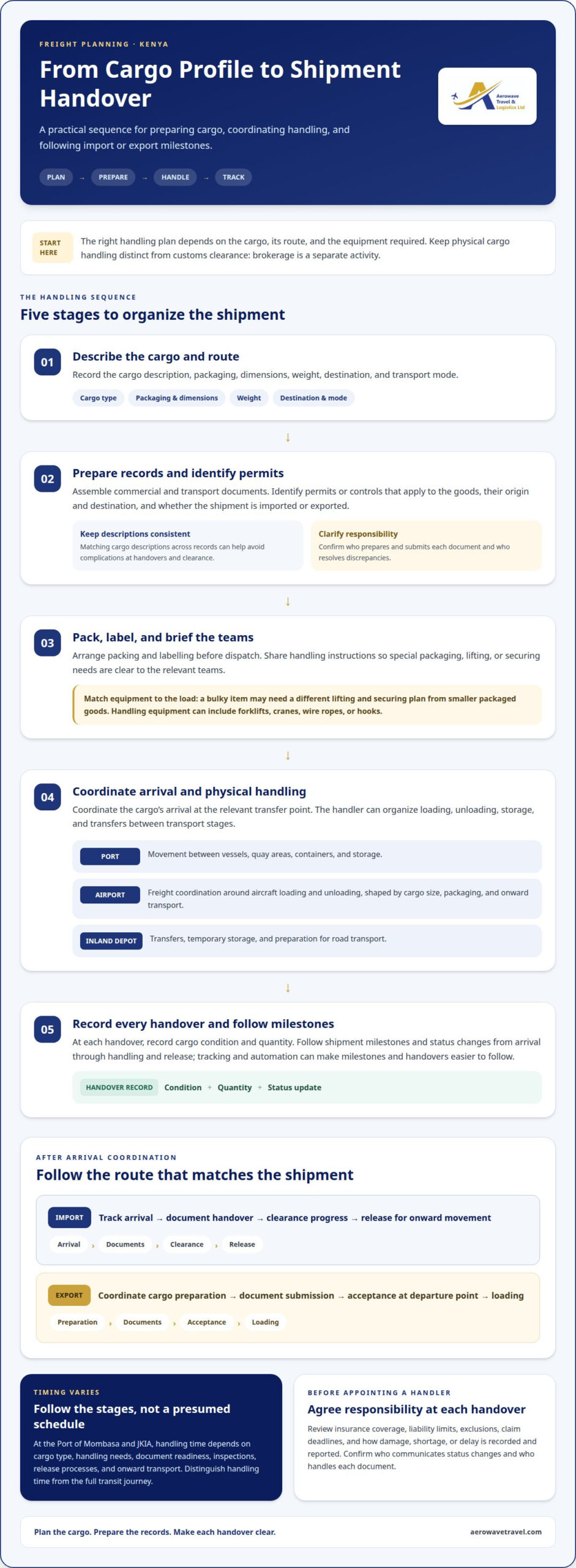
At a port, handlers move cargo between vessels, quay areas, containers, and storage. At an airport, teams coordinate freight around aircraft loading and unloading, with handling shaped by cargo size, packaging, and onward transport. Inland depots support transfers, temporary storage, and preparation for road transport. Compare services by handover point, equipment, storage arrangements, and how the handler coordinates with the cargo owner.
Cargo handling services may involve containers and lifting equipment such as forklifts, cranes, wire ropes, or hooks. Kenya’s handling operations have shifted from manual work towards mechanised services. Equipment must suit the load: a bulky item may need a different lifting and securing plan from smaller packaged goods.
Customs Documents, Rules, and Permits
Kenyan documents and permits depend on the goods, their origin and destination, and whether the shipment is imported or exported. Before dispatch, assemble the shipment’s commercial and transport records, then identify any commodity-specific permits or controls that apply. Keep cargo descriptions consistent across records, since mismatches can complicate handovers and clearance.
Distinguish physical handling from customs clearance. A cargo handler can coordinate the movement and storage of goods, while customs brokerage is a separate activity. Clarify who prepares and submits each document, and who is responsible for resolving discrepancies. For regulated or unusual goods, include applicable requirements in the shipment plan before packing and dispatch.
Import and Export Handling Steps
Start by describing the cargo, packaging, dimensions, weight, destination, and transport mode. Then prepare the commercial and transport documents and identify which permits apply. Arrange packing and labelling, then coordinate the cargo’s arrival at the port, airport, or depot. The handler can organise loading, unloading, storage, and transfers between transport stages.
For an import, track the shipment’s arrival, document handover, clearance progress, and release for onward movement. For an export, coordinate cargo preparation, document submission, acceptance at the departure point, and loading. At each handover, record the cargo’s condition and quantity. Share handling instructions with the relevant teams so any special packaging or lifting needs are clear.
Handling Times, Risks, and Liability
Handling time varies at the Port of Mombasa and JKIA. It depends on cargo type, handling needs, document readiness, inspections, release processes, and onward transport. Follow milestones from arrival through handling and release, and distinguish handling time from the full transit journey. This helps businesses locate delays without assuming every shipment follows the same schedule.
Before appointing a handler, review insurance coverage, liability limits, exclusions, claim deadlines, and responsibility at each handover. Ask how damage, shortage, or delay is recorded and reported. Safe work matters too: handlers need suitable protective equipment, clear lighting, functioning lifting equipment, and secure cargo storage. The cargo owner and handler should share instructions and supervise the agreed plan.
Which cargo handling companies operate in Kenya?
Kenya’s cargo-handling market includes businesses focused on freight movement, cargo storage, distribution, and shipment coordination. Their roles differ: one may handle physical cargo at a transfer point, while another coordinates freight across several stages. For a business, the key question is which functions the shipment needs and where responsibility passes between teams, not simply which company operates nearby.
A market snapshot dated September 19, 2026, found Nairobi represented 56.2% of matched cargo-handling company records in Kenya. This is a share of those records, not a measure of every operator or shipment in the country. It does point to Nairobi’s importance as a place to start comparing options, particularly when a shipment involves an inland depot or onward distribution. Businesses moving goods through Mombasa or JKIA should also focus on providers’ ability to coordinate those specific handovers.
The same snapshot reported a median employee-size band of 11-50 employees among matched companies. That figure describes the middle band in the dataset, not the staffing level or capability of any individual provider. A larger headcount alone does not establish that a company can manage a particular cargo type or route. Instead, map the shipment’s operational needs against the provider’s actual role:
- Physical handling: identify who receives, moves, stores, and releases the goods at each transfer point.
- Freight coordination: establish who organizes movement between the origin, transport mode, and destination.
- Warehousing and distribution: clarify whether goods need temporary storage, sorting, or onward delivery arrangements.
- Export support: distinguish cargo preparation and movement from customs brokerage, which is a separate activity.
Compare companies by scope, not labels. Ask for a clear description of each shipment handover, the records used to document it, and who communicates status changes. This makes gaps easier to spot. For example, a freight coordinator may arrange movement while a separate team handles cargo at a facility. Agreeing who updates the business at each stage can reduce confusion when the shipment changes hands.
The snapshot also recorded an average of 13.1 tracked contacts per matched company on September 19, 2026. This is a dataset measure, not a guarantee that a provider has that many operational contacts or a particular response process. Treat contact details as a starting point for understanding communication channels, then assess whether shipment updates identify the cargo, milestone, and next handover clearly. Businesses seeking coordinated freight movement can explore freight coordination options as part of planning their shipment.
Freight companies handling cargo usually act as agents for the cargo owner. Make that agency role explicit when discussing a shipment: identify whose instructions the company follows and which handling or coordination tasks are assigned to it. Keep the agreed scope tied to the cargo owner’s needs, and clarify where the company’s responsibility begins and ends. This distinguishes acting on the owner’s behalf from taking responsibility for every task in the shipment, and gives both sides a clearer basis for discussing handovers, status updates, and unresolved issues.
What are the cargo handling charges in Kenya?
There is no single charge for every Kenyan freight shipment. A quote depends on the handling work, transport route, cargo characteristics, and services included. For example, a pallet requiring straightforward loading differs from fragile goods that need careful packing and extra coordination. Compare itemised quotes by matching each task to an actual shipment requirement.
The price depends on the shipment and is provided after a quote request. Cost factors include cargo type, weight, volume, route, handling equipment, storage, and requested services.
Separate handling charges from other freight costs
A shipment estimate may combine several types of charges. Ask for a breakdown of physical handling, freight transport, storage, documentation support, and any other arranged work. These are distinct activities, even when presented together in one quotation. A Nairobi business shipping goods through Mombasa, for example, should identify which charges relate to movement at each handover.
Also clarify whether the estimate covers loading, unloading, packing, unpacking, or temporary storage. A quote for movement alone may exclude these tasks. If the shipment needs a forklift or crane, state that before requesting a price. This helps the provider describe the work accurately and reduces the chance of comparing unlike estimates.
Understand what changes the estimate
Cargo dimensions and weight can affect the handling method, equipment, and space required. A compact, heavy machine may need lifting equipment, while fragile cartons may need careful placement and protective packing. The route matters too: airport handling can involve different transfer points from cargo moving through a seaport or inland depot.
- Cargo details: provide the description, packaging, weight, dimensions, and any special handling instructions.
- Route and handovers: identify origin, destination, transport mode, and planned storage or transfer points.
- Work requested: list packing, lifting, loading, unloading, storage, and distribution tasks separately.
- Timing requirements: explain the planned arrival and dispatch sequence so the provider can scope coordination.
Compare quotations carefully
Use the same shipment details when requesting quotations from different companies. Then compare what each estimate includes, which handling stages it covers, and how additional work is described. A lower total may cover fewer tasks, so check whether storage, special lifting, or packing is listed separately.
Before accepting a quote, confirm the cargo description, units for dimensions and weight, route, and included work. Ask how changes are handled if the packaging, cargo quantity, or collection plan changes. Clear scope matters for air freight services, sea freight, and depot transfers alike. It gives the business a more useful basis for budgeting and coordinating the shipment.
How are cargo handling fees calculated by cargo type, weight, or volume?
A freight quote starts with the shipment’s physical details and the work required. For air cargo, the billing basis can reflect actual weight or the space occupied, depending on the shipment and applicable rate. Cargo type also affects how teams handle, secure, and transfer goods. Provide accurate measurements and a clear description when requesting a quotation.
Cargo type affects the handling plan
Sealed cartons differ from machinery, fragile goods, or pharmaceutical drums. The cargo description helps determine suitable packing, lifting equipment, storage, and handling instructions. For example, a delicate item may need protective packaging and careful placement, while a heavy machine may require lifting equipment. These needs affect the work included in the estimate, not just the cargo’s weight.
Packaging matters too. A well-secured pallet is easier to move as one load than loose items requiring separate handling. Share details about unusual shapes, fragile surfaces, or specific handling instructions. Clear descriptions help distinguish routine movement from tasks requiring extra coordination. Don’t label cargo only as “general goods” if that conceals important handling needs.
Weight and volume shape the rating basis
Actual weight describes how heavy the shipment is; volume describes the space it occupies. A dense, compact package and a light, bulky package can affect an aircraft’s available capacity very differently. Air-freight quotations for business exports can account for both measures when determining the applicable chargeable basis. The quotation should show which shipment measurements informed its calculation.
Measure each package after packing rather than estimating from the goods alone. Record its length, width, height, and weight using consistent units. For multiple packages, include the count and measurements for each size group. For example, a consignment with several large boxes and smaller cartons needs a breakdown, not one approximate dimension for the entire shipment.
Prepare details for a comparable estimate
Use the same information for every quotation. This lets your team compare the same shipment and work scope rather than unrelated totals.
- Describe the goods and note fragile, valuable, or unusual handling needs.
- Provide package count, individual dimensions, total weight, and packaging type.
- State the route, transport mode, and any planned storage or transfers.
- Separate requested tasks, such as packing, lifting, or distribution.
- Review the quoted measurement basis and included handling stages.
If the packed cargo changes, update its dimensions and weight before dispatch. A revised package count or larger crate can alter the space calculation and handling plan. For a business shipping machinery from Nairobi, accurate packed measurements help the freight team assess lifting needs and air-cargo capacity.
What documents are required for cargo handling and customs clearance in Kenya
For a Kenyan shipment, organise documents around the goods, route, and direction of travel. The cargo-handling file helps identify, move, and account for the shipment. Customs documentation supports clearance, which is separate from physical loading or transport. Keep both sets consistent so the cargo description and package details match at each handover.
Build a clear shipment file
A practical file can include a commercial invoice, packing list, and transport document. Air cargo uses an air waybill; sea freight uses a bill of lading. These records connect the goods to the shipper, consignee, package count, and route. Check that names, descriptions, quantities, and shipment references match across the documents.
For example, an export shipment of packaged products should have descriptions that match across its invoice, packing list, and transport record. The packing list should clearly state the number and contents of the packages. The transport document should identify the shipment and its movement. Accurate details make cargo identification and handovers easier to coordinate.
Match permits and supporting records to the goods
Some cargo categories require additional supporting documents or permits. The relevant records depend on the product, shipment origin and destination, and purpose. Build the file by identifying the goods first, then matching the applicable documentation to that category. Controlled or specialised products need closer document coordination than ordinary packaged merchandise.
Keep supporting records with the shipment’s core documents. Use consistent product names and quantities, and ensure the documents reflect the cargo as packed. If a shipment contains several product types, list them distinctly rather than combining them under a broad description. Clear records help each party understand what the cargo contains and which documents support its movement.
Coordinate document handovers and responsibilities
Before dispatch, assign responsibility for preparing, submitting, and sharing each document. The cargo owner should provide accurate goods information, while transport and handling teams need the records required for their respective tasks. Customs clearance is separate from cargo handling, so identify who manages each process. Do not assume a handler also acts as a customs broker.
Keep a current copy of the shipment file available to the teams managing each handover. When details change, such as package count or consignee information, update the relevant records together. For an air export from Kenya, align the invoice, packing list, and air waybill before cargo acceptance. For freight coordination around a prepared shipment file, plan air cargo and freight movement.
If cargo details change, update affected records before the next handover. Cargo handling operations need clear visibility, with lighting that is neither glaring nor dim. Safe cargo handling also requires supervision and cooperation between the handler and cargo owner.
A freight quote listing for bulk freight from Algeria to Mombasa, Kenya specifies a shipment weighing 8000 kilos. Keep that weight and route aligned across shipment records and handovers, while ensuring the working area remains visible to those coordinating the cargo.
Aerowave Air Travel and Logistics Ltd: Air Ticketing Services
Aerowave Air Travel and Logistics Ltd supports businesses coordinating travel and export needs alongside freight planning. Its Air Ticketing Services and Flight Booking Services can help arrange employee travel connected with a shipment, while Airport Transfers Services support ground travel for the journey. For businesses preparing goods to send abroad, Export Services can help coordinate export needs.
Keep the travel plan and cargo schedule aligned by sharing the intended journey dates, destination, and export requirements. Contact Aerowave Air Travel and Logistics Ltd to discuss your business travel or export needs.
Make your next shipment easier to coordinate
Use your next shipment to establish a clear working rhythm between your team and freight partners. Assign responsibility for shipment updates, keep key documents together, and record each handover. This gives staff a consistent reference as cargo moves through the supply chain. Tracking and automation can support the process by making shipment progress easier to monitor and routine updates easier to manage.
Choose cargo handling services that fit the shipment’s requirements, then align freight planning with the people who need to travel or support the export. Aerowave Air Travel and Logistics Ltd offers Air Ticketing Services, Flight Booking Services, and Airport Transfers Services for business travel needs.
Contact Aerowave Air Travel and Logistics Ltd to discuss your business requirements and plan the next step with confidence.
Frequently Asked Questions
What services are included in cargo handling?
Cargo handling services can include receiving and identifying a shipment, packing or unpacking it, moving it within a facility, and preparing it for the next transport leg. For example, a palletised order may need to be identified and positioned before dispatch. The exact scope depends on the cargo and facility. Define the tasks and handover point in the service arrangement, and distinguish physical handling from freight transport or customs brokerage.