
The flight is only one part of an export shipment. For Kenyan businesses, air freight for business exports moves commercial goods across borders by aircraft, with a freight forwarder coordinating space and transport. The process also involves preparing the cargo, arranging the required documents and managing the shipment from departure to arrival.
Air freight can suit urgent, valuable, perishable or lightweight goods, but it usually costs more than sea or road transport. A quote depends on factors such as chargeable weight, shipment dimensions, route, cargo requirements and available flight capacity. Understanding these details helps you decide whether air freight fits your delivery needs and budget.
This guide explains how the export process works, from booking through transit, which documents commonly support a shipment, and how actual and volumetric weight affect a quote. It also covers goods that may suit air shipping, helping you plan an export and keep the shipment moving.
Key Takeaways
- Estimate chargeable weight by comparing actual gross weight with volumetric weight; air freight uses whichever is higher.
- Prepare the commercial invoice, packing list and export declaration, alongside an Air Waybill and any documents required for the goods or destination.
- Follow the shipment from booking and cargo preparation through export clearance, aircraft loading and transit coordination.
- Consider air shipping for urgent, high-value, perishable or lower-volume goods when delivery speed justifies the higher transport cost.
- Use a freight service to coordinate cargo handling and shipment arrangements while you focus on export priorities.
What Goes Into an International Air Freight Quote?
An international quote reflects more than the flight. Cargo measurements, route, handling needs and delivery timing all matter. For Kenyan exporters, accurate shipment details help a freight forwarder coordinate transport and prepare a suitable quote.
Forwarding and Cargo Transport
International air freight forwarding coordinates commercial goods moving across borders on commercial or charter aircraft. A freight forwarder arranges cargo space and connects transport stages, helping exporters manage a shipment beyond the airport handover.
Which airlines and freight forwarders handle business air cargo exports from Kenya? Commercial airlines and dedicated cargo planes carry air cargo, while freight forwarders coordinate bookings and shipment logistics. The route and available flight capacity influence the quote and delivery plan.
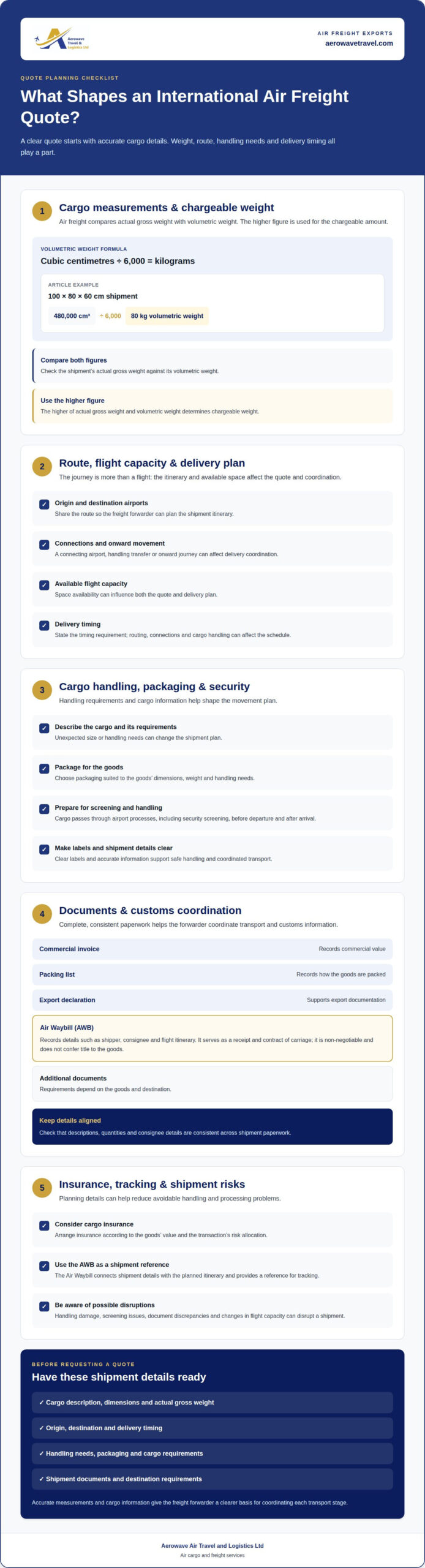
Weight affects the chargeable amount. Air freight commonly calculates volumetric weight by dividing cubic centimetres by 6,000 to obtain kilograms. A 100 × 80 × 60 cm shipment has a volumetric weight of 80 kg. Charges use whichever is higher: actual gross weight or volumetric weight.
Handling and Customs Clearance
Cargo handling covers preparation, acceptance and movement through airport processes, including security screening. Air freight cargo is subject to manual scrutiny and digital security checks before departure and after arrival, so packaging and shipment details should support safe handling.
How should exporters package, label, and insure goods for air transport? Choose packaging suited to the goods’ dimensions, weight and handling needs, and make shipment labels and documents clear. Arrange cargo insurance according to the goods’ value and the transaction’s risk allocation.
Customs clearance is a separate part of cross-border transport. A freight forwarder can coordinate logistics and customs clearance on an exporter’s behalf. Complete cargo information and aligned paperwork help reduce avoidable processing delays at the export stage.
Documentation and Compliance
Export documentation records what is shipped, its commercial value and how it is packed. Common documents include a commercial invoice, packing list and export declaration, alongside an Air Waybill. Additional documents depend on the goods and destination.
The Air Waybill records shipment details such as the shipper, consignee and flight itinerary. It serves as a receipt and contract of carriage, but it is non-negotiable and does not confer title to the goods.
Before cargo moves, the exporter and forwarder align documents with the shipment and destination requirements. Consistent descriptions, quantities and consignee details make it easier to coordinate transport and address customs information needs.
Shipment Security and Tracking
Security screening helps manage risks during air cargo handling, while shipment tracking follows the consignment through its journey. The Air Waybill provides a reference for shipment details and tracking, connecting the cargo record with its planned itinerary.
What are the risks of air freight exports, and how can businesses reduce delays or damage? Handling damage, screening issues, document discrepancies and changes in flight capacity can disrupt a shipment. Secure packaging, accurate paperwork and coordinated handling help reduce avoidable problems.
Quote factors also include origin and destination airports, cargo requirements, available flight capacity and delivery timing. Share accurate measurements and cargo details at booking, since an unexpected size or handling requirement can change the plan. This gives the freight forwarder a clearer basis for coordinating each transport stage.
What Is Air Freight Export and How Does It Work?
An air export moves commercial goods by aircraft, with routing and delivery coordinated between the shipper, carrier and receiving party. For Kenyan firms, air freight for business exports connects airport planning with the delivery requirements of overseas buyers.
Which Kenyan airports and cargo facilities are used for air exports? Nairobi’s Jomo Kenyatta International Airport (JKIA) is one airport used for export routing, with cargo handled through airport cargo facilities. The route and facility depend on the destination, flight connections and shipment requirements.
Routing and Delivery Coordination
Global routing links the export airport, any connecting airport and the destination airport through a planned transport itinerary. Coordination matters because a connection or handling transfer can affect the delivery schedule, particularly for sensitive cargo.
Air freight reaches destinations through commercial airlines and dedicated cargo planes. A freight forwarder coordinates space and shipment movement along the route, while the recipient’s location affects final delivery arrangements. For example, a shipment to a landlocked destination may need onward transport after arriving at an airport. This coordination makes air freight for business exports relevant when an order needs a clear route from departure to recipient.
Speed of Air Freight Delivery
Air freight generally moves goods faster than road haulage or sea freight, making it useful when delivery timing is a priority. Most international air freight shipments arrive within 24-72 hours, while air freight from Europe to Africa typically takes two to five days, depending on destination and routing.
Rapid transit can help exporters respond to urgent orders and avoid delays associated with port closures or congestion. However, total delivery time also depends on connections, cargo handling and the onward journey from the destination airport.
Delivery planning also covers how the recipient receives the goods. For a cash-on-delivery (COD) shipment, payment is collected from the recipient at delivery, according to the agreed arrangement. Proof of delivery records that the shipment reached its recipient, commonly through a delivery confirmation or receipt.
COD terms and proof-of-delivery procedures should be coordinated with the shipment’s delivery arrangement. These details matter when a Kenyan exporter needs evidence for an order record, payment follow-up or customer communication. A clearly defined recipient and delivery point connect airport arrival with the final handover.
For a shipment with several route stages, clear coordination keeps each handover aligned with the planned delivery. Businesses arranging export shipment planning can account for the airport route, any connecting leg and recipient handover as parts of one transport journey.
Air freight booking and documentation
Booking brings cargo details, available air transport and export paperwork together in one shipment plan. For a Kenyan exporter, the destination and goods determine the documents and handling arrangements needed.
Booking an Air Freight Shipment
Booking means arranging cargo space with a freight forwarder and sharing the details needed to plan transport. It matters because the booking information shapes the route, handling plan and export documentation.
Start with the destination, cargo description, package count, dimensions and gross weight. Include any handling needs, such as special care for fragile goods. These details help the freight forwarder coordinate suitable space and assess how the consignment fits the flight plan.
Booking information should match the cargo presented for transport. For example, if a shipment contains packages of different sizes, provide the measurements for each package rather than only the overall shipment weight. Clear details help align the booking with cargo acceptance and reduce corrections later.
Export Documentation
Export documentation identifies the goods, their commercial value, packing and movement. An air freight export commonly uses a commercial invoice, packing list, export declaration and Air Waybill.
The invoice describes the transaction and goods, while the packing list sets out how the shipment is packed. The export declaration records export information, and the Air Waybill connects the cargo to its carriage details. Additional documents depend on the destination and goods.
Prepare the paperwork around one consistent shipment description. For instance, the goods description and package quantities should match across the invoice and packing list. The Air Waybill includes details such as shipper, consignee and flight itinerary, making accurate names and routing information useful during coordination.
Documentation Compliance
Documentation compliance means preparing records that fit the shipment and destination requirements. It matters because incomplete or inconsistent paperwork can delay export processing or prompt questions during customs handling.
For each shipment, coordinate the commercial invoice, packing list and export declaration with the actual cargo. Check that descriptions, quantities, package counts and shipper or consignee details agree across documents. A mismatch, such as different package totals on the invoice and packing list, can require clarification before movement proceeds.
The destination and cargo type can call for additional paperwork. A particular product may need supporting documents beyond the common export set, depending on its destination. The freight forwarder coordinates transport documents, while the exporter supplies accurate commercial and cargo information for the shipment record.
Keep the final document set connected to the booked consignment. When cargo details change after booking, update the relevant records so the paperwork continues to describe the shipment being presented. This supports smoother handovers between export preparation, customs processing and air transport.
Air freight suitability for urgent and high-value goods
Air freight suits shipments where delivery speed, cargo value or limited shelf life matters more than the lower cost of slower transport. The decision is strongest when a delay could affect product quality, customer commitments or the value of the order.
Which goods are restricted or require permits for air export from Kenya? Requirements depend on the goods and destination, and some shipments need additional documents. Class 7 radioactive materials are excluded from air cargo, so cargo type must be considered before arranging transport.
Perishable products are a clear example of time-sensitive cargo. Kenya’s cut-flower exporters rely on air transport to move flowers to overseas buyers while freshness matters. Businesses shipping produce can weigh delivery urgency against the handling and transport costs involved.
High-value goods may also justify air freight when a faster route supports a priority order or reduces the time cargo spends in transit. For example, a business sending a small, valuable consignment to meet a buyer’s deadline may value speed more than a slower mode. The decision depends on the goods, schedule and cost impact of delay.
Air freight can also suit fragile, lightweight or low-volume cargo. Careful handling starts with packaging suited to the product and its journey, including transfers between transport stages. A fragile item needs protection against movement and impact, while a perishable shipment may need handling appropriate to its condition and delivery schedule.
Special and dangerous goods need attention before booking because cargo characteristics affect acceptance, packaging and handling. Describe the goods accurately, including any relevant handling needs, so the freight plan reflects what is actually being shipped. Class 7 radioactive materials cannot travel as air cargo; other special cargo may have requirements shaped by its nature and destination.
For a regular export programme, air and sea freight can serve different priorities. A business might use sea freight for planned stock replenishment, then consider air freight for an urgent order or an unexpected change in demand. This lets the exporter match the transport mode to each order’s timing rather than treating every shipment alike.
Before choosing air freight, compare the consequences of delay with the added transport cost. A replacement component needed to keep a customer’s operation running may be more time-sensitive than routine stock. For a fragile, perishable or high-value consignment, align the packaging, handling plan and delivery timing with its specific needs.
Air cargo can accommodate small packages through oversized cargo, including shipments that do not require a full container load. This flexibility helps businesses assess each consignment on its own dimensions and priority. The most suitable choice depends on cargo type, urgency, destination and the value of reaching the recipient promptly.
Air freight export process
A Kenyan air export moves through coordinated stages, from cargo planning to destination delivery. Each handover connects the shipment to the next part of the supply chain, so accurate information supports reliable operations.
- Plan the shipment. The exporter shares the destination, cargo description, package dimensions, gross weight and handling needs. These details help the forwarder assess the shipment and coordinate suitable air transport. For example, a fragile consignment needs handling arrangements that reflect its packaging and contents.
- Arrange cargo space. The exporter books space through a freight forwarder, which coordinates transport with commercial airlines or dedicated cargo planes. The route depends on the destination, available flight capacity and delivery timing. Connections may add handovers between the Kenyan departure airport and the destination airport.
- Prepare cargo and records. Goods are packed for their journey, while the shipment information is aligned with its export documents. The commercial invoice, packing list, export declaration and Air Waybill support the cargo record. Additional documents depend on the goods and destination.
- Present cargo for processing. At the airport, cargo is accepted and handled for export procedures. Air freight cargo faces manual scrutiny and digital security before departure. The exporter’s accurate shipment details help the forwarder coordinate cargo handling and address questions during processing.
- Complete export clearance and load. The shipment proceeds through export customs clearance before loading onto the aircraft. After clearance, cargo is loaded, and the forwarder monitors its progress during transit. This stage connects export processing with the flight and planned route.
- Coordinate arrival and delivery. At the destination, the shipment moves through arrival handling and import processes before onward delivery. The consignee, destination arrangements and cargo type shape the final handover. A clear delivery point helps connect airport arrival with the recipient’s supply chain.
Changes can affect more than the flight itself. If package measurements change after booking, the cargo information and transport plan may need adjustment. If the destination or delivery timing changes, the freight forwarder must coordinate the revised route and handovers. Keeping shipment details consistent helps each party work from the same plan.
For Kenyan businesses, the key takeaway is to treat the export as a connected journey, not just an airport booking. Cargo readiness, export clearance, flight movement, destination import handling and delivery all shape the outcome. Coordinating these stages helps businesses plan around order priorities and maintain supply chain continuity.
Arrange air cargo export support to coordinate the shipment journey from booking through transit and delivery planning.
Aerowave Air Travel and Logistics Ltd: Air Cargo and Freight Services
Aerowave Air Travel and Logistics Ltd provides Air Cargo and Freight Services and Cargo Export Services for businesses planning international shipments from Kenya. Turn to these services when you need help coordinating cargo transport for an export order, especially when timing, shipment details and delivery arrangements must align.
Prepare the destination, cargo description, package dimensions and weight, and any handling needs. These details help shape the transport plan and booking. Aerowave also offers Flight Booking Services and Airport Transfers Services for related travel arrangements, while cargo logistics remain the focus for goods exports.
Share your shipment requirements with Aerowave Air Travel and Logistics Ltd to discuss your export cargo arrangements.
Plan your next export shipment with confidence
As your export programme develops, treat each shipment as part of a wider business decision. Match transport choices to customer commitments, stock priorities and each order’s role in your growth plans. This helps make air freight for business exports a considered logistics choice rather than a last-minute response.
Aerowave Air Travel and Logistics Ltd supports cargo planning through its Air Cargo and Freight Services. For teams coordinating travel around export activity, it also offers Air Ticketing Services, Flight Booking Services and Airport Transfers Services. These services address practical needs, from arranging freight to planning business travel.
Share your shipment requirements and the outcome you need to support. Contact Aerowave Air Travel and Logistics Ltd to discuss your export cargo plans and take the next step with a clear direction.
Frequently Asked Questions
What are the differences between air freight and express air shipping?
Express air shipping generally suits small, urgent consignments, while freight forwarding by air suits larger commercial shipments or those with complex logistics. For example, a business sending a time-critical sample may choose express, while regular export stock may need a coordinated freight booking. The right option depends on shipment size, urgency, cargo requirements and destination arrangements, not simply on the aircraft used.
Conclusion: Is Air Freight the Right Choice for Your Business?
Air freight may suit your business if delivery speed, product freshness or the cost of a delay outweighs the higher transport cost. Consider a replacement part needed for a customer order, or perishable goods with a narrow delivery window. For planned, bulky stock without an urgent deadline, another transport mode may fit better. Base your decision on the shipment’s value, timing and role in your supply plan.
How is air freight cost calculated?
Air freight charges use chargeable weight, the higher of actual gross weight and volumetric weight. Volumetric weight converts package size into a weight figure, so a light but bulky consignment can be charged by volume. The quote also depends on the origin and destination airports, cargo requirements, available flight capacity and delivery timing. Accurate package measurements help make the estimate relevant to the cargo.
What Are the Advantages of Air Freight?
Air freight can move goods faster than road haulage or sea freight, helping businesses serve urgent orders and reach destinations where slower routes take longer. It can also reduce exposure to delays linked to port congestion or closures. Businesses can ship cargo ranging from small parcels to oversized consignments without needing a full container load. These benefits matter most when the delivery schedule or product condition is a priority.
How does air freight work for business exports from Kenya?
A Kenyan exporter arranges cargo space, prepares shipment details and export documents, then presents the goods for airport processing. After export customs clearance, the cargo is loaded onto an aircraft and its movement is coordinated during transit. Destination import handling and onward delivery complete the journey. For example, a Nairobi exporter serving an overseas buyer must plan both the airport route and final delivery arrangements.
What documents are required to export goods by air from Kenya?
Common air export documents include a commercial invoice, packing list, export declaration and Air Waybill. The invoice describes the commercial transaction, while the packing list records how the goods are packed. The Air Waybill identifies carriage details, including the shipper and consignee. Additional paperwork depends on the cargo and destination, so specialised goods may require supporting documents beyond the common set.
What are Kenya’s customs clearance steps and export regulations for air freight?
Air export processing includes presenting shipment information and documents for export customs clearance before cargo is loaded onto the aircraft. The export declaration forms part of the standard document set, while the goods and destination can affect additional paperwork. The destination country’s import process applies after arrival. Coordinate export documents with the actual goods and keep cargo descriptions and quantities consistent across shipment records.
How much does air freight from Kenya cost per kilogram, and what affects the price?
Air freight rates per kilogram depend on the shipment and route, so one rate cannot represent every export. The price depends on the shipment details and is provided in a quote. Key factors include chargeable weight, dimensions, origin and destination airports, cargo handling needs, flight capacity and delivery timing. A bulky, light consignment may have a higher volumetric weight than its scale weight, affecting the quoted charge.