
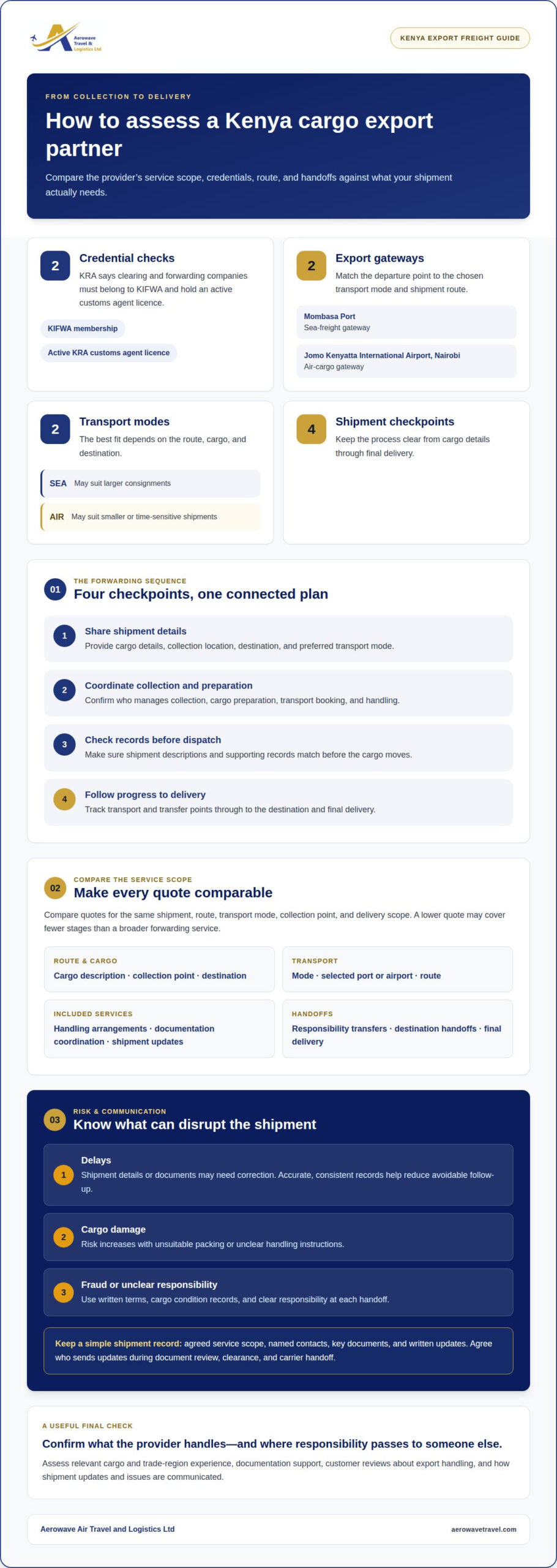
A reliable cargo export partner in Kenya should coordinate freight forwarding, provide clear shipment updates, and understand your cargo and destination. The Kenya Revenue Authority (KRA) says clearing and forwarding companies in Kenya must belong to the Kenya International Freight and Warehousing Association and hold an active customs agent licence. These checks help you assess whether a provider can manage the parts of the export process your shipment needs.
Dependable delivery involves more than moving cargo. It also relies on clear communication and careful coordination of export procedures. This guide explains how to assess a forwarder’s service scope, credentials, regional experience, documentation support, and tracking approach. You’ll learn what to consider from collection through delivery, making it easier to compare options and follow your shipment’s progress.
Key Takeaways
- Map the forwarding process from cargo collection through delivery, and make sure its scope fits your shipment.
- According to the Kenya Revenue Authority, clearing and forwarding companies in Kenya must belong to KIFWA and hold an active customs agent license.
- Look for experience relevant to your cargo type and trade region, not just general freight knowledge.
- Organise export documents carefully, as proper documentation can help reduce delays when cargo enters Kenya.
- Assess how the forwarder shares shipment updates and communicates issues, so you can follow progress with greater clarity.
Freight forwarding process from collection to delivery
A forwarding plan links cargo collection in Kenya with export handling, transport, and delivery at the destination. Compare the provider’s services with your shipment’s route, cargo type, and tracking needs.
Export Hubs and Service Scope
Freight forwarding can cover collection, cargo preparation, transport booking, export documentation, handling, and delivery arrangements. Clarify which stages the forwarder manages and where responsibility passes to another party.
Mombasa Port is a sea-freight gateway, while Jomo Kenyatta International Airport in Nairobi handles air cargo. Sea freight may suit larger consignments, while air freight may suit smaller or time-sensitive shipments. The best fit depends on the route, cargo, and destination.
For international freight forwarding, clarify how the provider coordinates transport beyond Kenya’s departure point. Compare the collection location, selected port or airport, destination handoffs, and final delivery arrangements. Look for customer reviews that describe export handling, communication, and issue resolution, rather than relying on general ratings alone.
Quotes, Costs, and Export Risks
Compare quotes for the same route, cargo description, transport mode, collection point, and delivery scope. Check what each service includes, such as handling arrangements, documentation coordination, shipment updates, and responsibility at handoffs. A lower quote may cover fewer stages than a broader forwarding service.
Export costs depend on the cargo’s dimensions and weight, route, transport mode, and handling requirements; the price is given after a quote request. Delays can arise when shipment details or documents need correction, while damage risks increase with unsuitable packing or unclear handling instructions. Reduce confusion with written terms, cargo condition records, and clear responsibility at each handoff.
Freight forwarding typically follows a sequence. First, the shipper provides cargo details, collection location, destination, and preferred transport mode. The forwarder coordinates collection and prepares the cargo for the planned route. Before dispatch, confirm that shipment descriptions and supporting records match. After export handling, follow progress through transport and transfer points until delivery.
Which Kenyan forwarders specialise in cargo exports and have strong customer reviews? Look for feedback that discusses export shipments, tracking communication, and problem resolution. A general star rating alone does not show whether reviewers used comparable services.
How should you compare quotes and service terms? Match each quote to the same shipment, route, mode, and delivery scope, then compare included handling and handoff responsibilities. What are the main risks? Delays, cargo damage, and fraud can disrupt an export. Written terms, accurate shipment records, and traceable communication help manage these risks.
Match a forwarder’s service scope to your freight requirements before choosing a provider. Assess whether the proposed support fits your shipment, and clarify any gaps before proceeding. This keeps the decision focused on the work required, not just the service description.
Industry accreditation and customs-agent licensing
Accreditation and licensing help distinguish a forwarding company’s role from customs clearance authority. The Kenya Revenue Authority (KRA) says clearing and forwarding companies in Kenya must belong to the Kenya International Freight and Warehousing Association and hold an active customs agent licence. These are specific credentials, separate from general claims about experience or customer service.
KIFWA membership and an active KRA customs agent license address different checks. Membership identifies an industry association relationship, while the license relates to customs agency. Together, they provide a useful starting point when assessing a company that clears and forwards cargo. They don’t, by themselves, explain which shipment tasks the company will handle.
Define responsibilities before cargo moves. A forwarding arrangement may include transport coordination and export documentation, while customs clearance is a distinct function. Set out who prepares or submits shipment information, who handles customs-agent duties, and who communicates if a record needs correction. This prevents assumptions about responsibility at each stage.
What are Kenya’s export customs clearance procedures and timelines? The practical sequence is to prepare accurate shipment details, coordinate the relevant export records, arrange clearance through the responsible customs agent, and proceed with transport after the required processing. Timing depends on record readiness, any corrections or checks, and coordination between the agent and carrier.
For a shipment moving from Nairobi overseas, keep details such as cargo description, quantity, and destination consistent across the documents used for coordination. Discrepancies can prompt follow-up and slow the next handoff. Accurate documentation also helps reduce delays when cargo enters Kenya, according to the market guidance available for this topic.
Customer service matters throughout the process. Agree on a communication method and identify who will send updates during document review, clearance, and carrier handoff. If a detail changes, such as the collection schedule or cargo description, the responsible contact should explain how it affects the next step. Clear updates make issues easier to resolve.
Keep a simple shipment record with the agreed service scope, named contacts, key documents, and written updates. This provides a reference if the cargo description changes or a question arises during clearance. It also helps distinguish an administrative delay from a transport delay, so the right party can address the issue.
Licensing is a starting point, not a substitute for clear service terms. Match the forwarder’s role to the clearance tasks your export requires, and identify the customs agent responsible for those tasks. For support organising an export plan, explore export shipment planning.
Experience and trade-region expertise
Freight experience is most relevant when it matches the cargo, export route, and handling needs. A forwarder familiar with general transport may need different processes for fragile goods, bulky freight, or shipments involving several handoffs. Assess industry knowledge and destination experience, rather than treating time in logistics as the only measure. A reliable cargo export partner in Kenya should explain how relevant experience informs the shipment plan.
Start with the cargo. Fragile products, for example, need careful packing coordination and clear handling instructions, while bulky freight may require different loading arrangements. Perishable goods have their own timing and handling considerations. These examples show why experience should match your shipment’s characteristics, not just a broad service category.
Next, consider familiarity with the destination and route. A shipment from Nairobi to Kampala or from Mombasa to the United Kingdom may involve different carriers, transfer points, and delivery arrangements. Ask how the forwarder plans for each handoff and keeps route information clear. This is a more useful measure of regional expertise than a general claim of international experience.
Use consistent criteria when assessing a provider’s experience:
- Cargo fit: Does the forwarder understand your goods and their handling needs?
- Route familiarity: Can the plan account for the destination and shipment handoffs?
- Process clarity: Can the forwarder explain how the cargo moves from collection to delivery?
- Issue handling: Is there a clear way to communicate changes or disruptions?
Consider a Kenyan exporter sending packaged goods to a customer in Canada. Relevant regional knowledge helps the forwarder explain the route, transfer points, and delivery coordination. If the destination changes to Europe or the United States, the transport plan may change too. Choosing a reliable cargo export partner in Kenya means assessing whether its experience fits the actual route, not just the original booking.
Look for examples involving comparable cargo and destinations. Customer feedback is more useful when it describes a similar freight requirement, route, or communication issue. General praise for speed offers little insight if it does not explain the shipment type or how the forwarder handled a change.
Finally, connect experience to your operating needs. A suitable partner can explain how cargo knowledge and route familiarity shape handling, handoffs, and updates. This helps you judge whether the proposed plan fits your export requirements. A shipment routed through Nairobi, for instance, may need different coordination from cargo collected in Mombasa, even when both consignments share a destination.
The explanation should connect the provider’s logistics background to the goods and market involved. Check that a freight forwarder has experience in your industry and trade region, as well as in logistics generally. This helps distinguish broad shipping familiarity from experience relevant to the planned movement.
Ask the provider to describe comparable work and explain how that experience informs the route and handling approach. The aim is to understand whether its expertise fits your cargo and destination, not to collect general claims. If the explanation is vague, seek clearer examples before deciding whether the experience is a good match.
Export procedures
A clear export procedure turns a sales order into a shipment plan. In Kenya, start by defining the goods, collection point, destination, transport mode, and intended delivery arrangement. These details help the forwarder coordinate the route and identify information needed from the exporter. If a shipment contains several product types, describe each separately rather than using a broad label.
Next, organise shipment information before collection. Make sure the goods’ descriptions and quantities match across commercial records and transport instructions. For example, if a consignment contains cartons of different products, record the contents and quantities clearly. The forwarder can use consistent details to coordinate handling and prepare the relevant export paperwork. Requirements vary by cargo and destination, so base the plan on the actual shipment.
- Share shipment details. Provide the cargo description, quantities, dimensions, weight, collection address, destination, and preferred transport mode.
- Review the proposed route. Confirm how cargo will travel from collection to its departure point and through transfer stages.
- Prepare and align records. Check that commercial information and transport instructions describe the same goods and destination.
- Coordinate collection and handling. Set the collection arrangements and communicate any packing or handling requirements.
- Follow the shipment through handoffs. Keep the contact, shipment reference, and updates together until delivery.
Before dispatch, resolve any differences between records and the physical cargo details. A changed quantity, revised destination, or updated collection address can affect transport coordination. Send corrections through the agreed contact and use the latest version of each record. This simple version-control step helps prevent staff from relying on outdated shipment instructions.
Export paperwork varies by shipment. Cargo type, route, transport mode, and destination influence which records and handling details apply. Sea and air shipments involve different transport arrangements, so ensure the documents and instructions match the selected route. Requirements for regulated or specialised goods may also affect preparation. Account for these factors before collection.
Communication connects each stage. The exporter supplies accurate cargo information, while the forwarding team coordinates the agreed transport stages and shares relevant updates. Record who handles each task, including document preparation, collection scheduling, and communication about changes. If cargo details change after booking, notify the responsible contact promptly so the transport plan can be reviewed.
For example, a Kenyan business shipping packaged goods to an overseas buyer can start with a complete cargo description and destination details. It can then align its commercial records with the forwarding instructions, coordinate collection, and keep shipment updates together. This structured approach makes export coordination easier to follow and helps identify discrepancies before they disrupt a handoff.
Shipment updates and cargo tracking
Tracking an export shipment from Kenya depends on a clear reference and useful progress updates. Agree on how the shipment will be identified, which milestones will be reported, and who will communicate changes. A tracking number is useful only if it connects to information about the cargo’s progress and next stage.
How can businesses track export shipments from Kenya and insure cargo? Use the shipment reference to follow reported milestones, and agree on how delays or route changes will be communicated. Consider cargo insurance separately by reviewing the policy’s covered goods, route, transit period, exclusions, and claims process before dispatch.
A practical update plan can follow the shipment’s main handoffs:
- Collection: Record when the cargo leaves its collection point and who has received it.
- Export handling: Note when the shipment reaches its departure hub and when it is prepared for onward transport.
- Transit: Keep updates on transfers, route changes, or disruptions together with the shipment reference.
- Delivery: Record the delivery status and any issue reported at arrival.
Each update should clarify the next step. For example, a message saying that a shipment is awaiting transfer is more useful if it also identifies the responsible contact and the next expected update. Agree on a communication channel, such as email, and keep the latest messages together. This helps your team distinguish a normal handoff from a delay that requires action.
Responsiveness matters most when something changes. If a carrier reports a disruption, the forwarder’s update should explain what happened, how it affects the planned route, and what happens next. Clear communication helps the exporter coordinate with the receiving customer, adjust internal plans, and record decisions. Keep written records of important shipment changes rather than relying on informal verbal updates alone.
Insurance serves a different purpose from tracking. Tracking provides progress information, while insurance may provide financial protection under the policy’s terms. Before cargo leaves Kenya, make sure the declared cargo value and description match the shipment documents. Review whether the policy covers the planned route and handling stages, and retain relevant records, such as shipment documents and condition details.
Keep a simple shipment file with the reference, route, status messages, key contacts, and insurance documents. For a consignment with several transfers, this record helps your team see which stages are complete and where a question arose. A dependable update process also gives the exporter a clearer basis for responding to the buyer.
For coordinated shipment handling and progress communication, arrange your cargo export.
Aerowave Air Travel and Logistics: Export Services
Aerowave Air Travel and Logistics Ltd provides Export Services for businesses coordinating cargo shipments from Kenya. Turn to its team for help planning export arrangements and coordinating freight details around your cargo, route, and delivery requirements. Clear shipment information helps define the service scope and supports smoother coordination from the outset.
Whether you’re preparing a consignment for an overseas customer or arranging freight for a business shipment, share the cargo details, destination, and preferred transport mode. Aerowave Air Travel and Logistics Ltd can help organise the export process, leaving you free to focus on your customers and operations.
Contact Aerowave Air Travel and Logistics Ltd to discuss your export shipment.
Prepare Your Next Export with Confidence
Your next step is to turn your shipment requirements into a workable plan that supports your business priorities. Choosing a reliable cargo export partner in Kenya means finding a service that fits how you need to move goods, while allowing you to coordinate related travel needs when they arise.
Aerowave Air Travel and Logistics also offers Air Ticketing Services, Flight Booking Services, and Airport Transfers Services. These can help when export planning overlaps with staff travel or airport transport. Considering travel arrangements alongside export needs can help your team plan its responsibilities more clearly.
Share the nature of your shipment, its destination, and the support you need to begin a practical conversation about next steps. Contact Aerowave Air Travel and Logistics about your export requirements and move forward with a clear plan for your cargo.
Frequently Asked Questions
How can I verify that a cargo export company in Kenya is reliable and licensed?
Confirm the company’s membership with the Kenya International Freight and Warehousing Association (KIFWA) and its active customs agent licence with the Kenya Revenue Authority (KRA), which KRA requires for clearing and forwarding companies in Kenya. Use the company’s registered name and licence details for these checks. Then assess reliability through clear written service terms, shipment-specific experience, and customer feedback about how export issues were handled.
What export cargo services do Kenyan logistics companies offer, including air, sea, and road freight?
Kenyan cargo services can coordinate freight by air, sea, and road. The suitable option depends on the cargo, destination, schedule, and handling needs. Aerowave Air Travel and Logistics Ltd coordinates cargo services for parcels through large consignments, with air, sea, and road freight options. Exporters can compare modes against their shipment’s route and requirements, then match the service scope to the journey.
What documents are required to export goods from Kenya?
Documents depend on the goods, destination, transport mode, and requirements that apply to the shipment. Prepare accurate commercial records describing the goods and quantities, along with the consignee and destination details needed for transport coordination. Keep these details consistent across shipment instructions and supporting paperwork. For mixed-product shipments, separate descriptions and quantities can make cargo information clearer at each handling stage.
Which Kenyan freight forwarders specialize in cargo exports and have strong customer reviews?
Look for providers whose customer reviews discuss export shipments, tracking communication, and problem resolution. A general star rating alone may not reflect experience with comparable services.