
A shipment is only ready to export when its market, paperwork and route work together. In Kenya, export services can help coordinate freight, prepare export documentation and organise shipment requirements for the destination market. The exact documents and product compliance requirements depend on what you’re exporting and where it’s going.
Expanding across borders means coordinating several moving parts: finding suitable buyers, meeting product requirements, and managing export and customs processes. A clear plan puts these tasks in sequence and shows what needs attention before a shipment leaves Kenya.
This article explains how export support can help with customs clearance preparation, buyer research, target-market compliance and cross-border supply arrangements. You’ll also learn what can affect the process and how freight and logistics coordination fits into a practical export plan.
Key Takeaways
- Match product requirements to the destination market before arranging a shipment, since compliance gaps can disrupt clearance.
- Plan cross-border service delivery around how the work will reach the customer, as requirements vary by market and supply method.
- Use the relevant Kenyan agencies and export support to coordinate market entry and the practical steps behind reaching overseas buyers.
- Identify product-specific export documents early, especially for food and agricultural goods, where permits or certificates may apply.
- Choose freight arrangements around the shipment’s needs, then consider Aerowave Air Travel and Logistics for export coordination.
Product compliance with target-country requirements
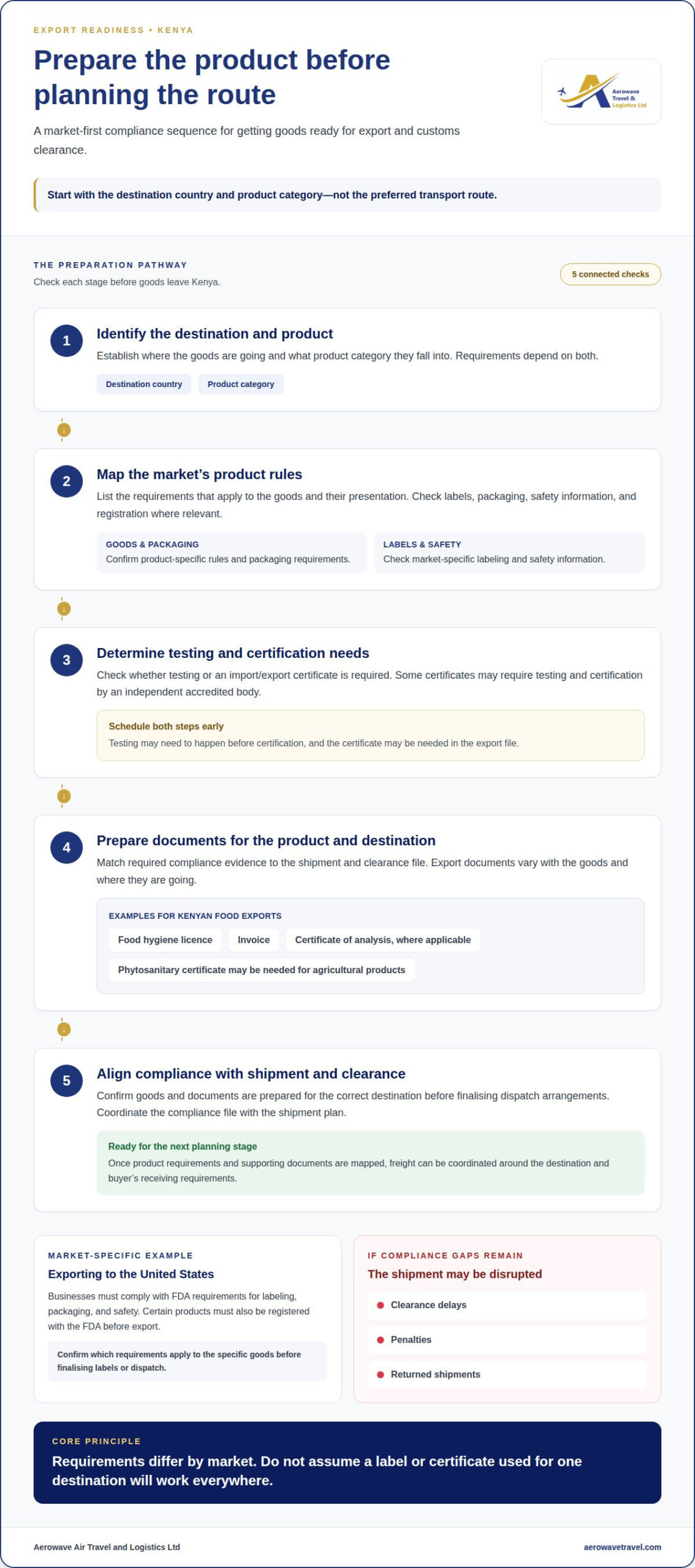
Before a Kenyan exporter sends goods abroad, the product must meet the destination market’s rules. Most countries require products to conform to national and international standards. Those requirements can affect labels, packaging, safety information, testing, and certificates. The exact obligations depend on the product and the country receiving it. A shipment plan should therefore begin with the destination and product category, not only the preferred transport route.
First, identify the intended market and the rules that apply to the product. Map each requirement to the goods, packaging, and supporting documents. Packaged food, for example, may face different checks from a manufactured component. A label prepared for one market may not meet another’s requirements, so confirm that the goods and documents are prepared for the correct destination before arranging shipment.
The United States illustrates why market-specific checks matter. Businesses exporting there must comply with FDA requirements for labeling, packaging, and safety. Certain products must also be registered with the FDA before export. These obligations make product classification and preparation important parts of shipment planning. Exporters should establish which requirements apply to their specific goods before finalising labels or dispatch arrangements.
Product testing and certification may also be required. An import or export certificate may require testing and certification by an independent accredited body. Since testing may need to precede certification, and the certificate may be needed in the export file, include both steps in the schedule rather than leaving certification until the last moment.
Non-compliance can affect the entire shipment. Where product compliance is required, exporters need to meet those requirements for customs clearance. Gaps can lead to clearance delays, penalties, or returned shipments. Review product rules alongside the paperwork and dispatch plan to identify missing evidence before the goods are in transit.
A practical review can follow these steps:
- Identify the destination country and the product category.
- List the applicable rules for labels, packaging, safety, and registration.
- Determine whether testing or certification is required.
- Arrange any required assessment with an independent accredited body.
- Align compliance documents with the shipment and clearance file.
For example, a Kenyan business preparing goods for the United States should account for FDA labeling, packaging, and safety requirements. If registration applies, include it in the plan before export. Requirements differ by market, so do not assume that a label or certificate used for one destination will work everywhere.
Keep market-specific requirements with the product and shipment details. This gives the team a clear reference for preparation, certification, and clearance coordination. Addressing destination rules before goods leave Kenya helps reduce avoidable uncertainty as the shipment travels to its overseas buyer.
Requirements for cross-border supply
For Kenyan exports, applicable taxes, duties, and fees depend on the product, destination, and transaction. Companies supplying services to non-EU countries need to check which local taxes and VAT payments apply.
Shipping and Freight Options
Choose a shipping plan based on the goods, destination, and delivery arrangement. Air freight may suit the shipment, but its characteristics and route shape the practical choice. Align transport with the export documents and the buyer’s receiving requirements so movement, paperwork, and delivery arrangements stay connected.
Export Documentation
Documentation depends on what is being exported and where it will go. For Kenyan food exports, listed clearance applications require a food hygiene licence and an invoice, plus a certificate of analysis where applicable. Agricultural products may also need a phytosanitary certificate. Match the documents to the product and destination before dispatch planning is finalised.
Services can reach overseas customers through different modes of supply, and requirements depend on the chosen mode and target market. Remote delivery may involve different arrangements from work performed through an affiliate abroad or by travelling to the customer’s market. Define the delivery model first, then map its requirements.
Legal services illustrate these distinctions. A lawyer may serve an overseas customer by email, through an established affiliate abroad, or by travelling there. Each method changes how the service reaches the customer and what cross-border arrangements the business needs to plan. Settle the delivery method before making commitments.
Travel-based supply has its own conditions. Business visitors supplying services in a foreign market often stay for a period limited to 3 months. In the short-term stay described, the visitor receives no remuneration in the foreign country. A business planning in-person delivery should therefore account for the permitted stay and the payment arrangement in its target market.
For service exports to non-EU countries, local taxes and VAT payments require attention. Obligations depend on the target market and supply arrangement. Consider tax alongside the delivery method, customer contract, and any travel plans, rather than treating it as an afterthought.
A practical planning sequence is to select the target market, define how the service or goods will reach the buyer, and identify the related requirements. Then coordinate freight, documents, travel, and local tax considerations around that plan. For shipments involving air transport, cross-border shipment coordination can help connect freight planning with the wider export process.
Keep the payment condition visible when setting the service schedule and agreeing how work will be delivered. During the short-term stay described, a business visitor supplying services abroad receives no remuneration in the foreign country. Treat the stay and payment arrangement as linked planning points, and check that the proposed delivery model, customer commitments, and visa consultancy services remain consistent before service begins. This helps ensure that the planned arrangement reflects the conditions already identified for travel-based supply.
Which Kenyan agencies and companies provide export services?
Kenyan companies export services in fields such as technology, construction, and property consulting. The provider delivers the work, while freight and logistics arrangements support physical shipments. The right support depends on whether the export is a remote service, an overseas project, or goods crossing a border.
Kenyan IT companies export fintech, business process outsourcing, and software development services to global corporations, including clients in the United States and Europe. These examples show how a Kenyan provider can serve an overseas customer without shipping a physical product for every transaction. The service itself, such as software development, is the export.
A business seeking an IT partner should begin by defining the work and destination market. A fintech project for a US corporation differs from business process outsourcing for a European client. Scope, delivery method, and customer expectations shape the arrangement, so define what the Kenyan firm will deliver.
Kenyan construction firms and real estate consultancies also export professional services. Their work can include architectural design and project management for customers in Uganda and Rwanda, including projects connected to Kampala and Kigali. These examples connect Kenyan expertise with regional projects. A consultancy may contribute design work, while project management supports coordination across the construction process.
For regional assignments, identify the required service before selecting a provider. Architectural design and project management involve different skills and deliverables. The destination matters too: a project in Kampala or Kigali may involve a different customer relationship and delivery method. Define the expected output, responsibilities, and communication process at the start.
Companies considering providers can organise their needs around a few practical points:
- Specify the service, such as fintech, software development, or architectural design.
- Name the intended market, such as the United States, Europe, Kampala, or Kigali.
- Describe whether delivery is remote or connected to an overseas project.
- Set out the expected work and how the customer will receive it.
Kenyan IT firms and professional consultancies are examples of service exporters, but they do not cover every export need. A business shipping products must also plan the movement of goods and related logistics. Separate the service provider’s role from shipment coordination to identify the support needed for each part of the export.
Different agencies and companies can have distinct roles in an export process. A Kenyan consultancy may deliver architectural design, while a technology firm may provide software development. For a goods shipment, the product and destination determine the operational needs. Identify the export type first, then match each task to the appropriate provider or business function.
What documents are required to export goods from Kenya?
Documents depend on the goods being exported from Kenya. Food, animal products, and agricultural goods may require different permits or certificates. Identify the product category, then match it to the applicable documents. For food export clearance applications, listed requirements include a food hygiene licence and an invoice, with a certificate of analysis where applicable.
Animal products have specific document requirements. Fish exports require an export permit or licence from the Fisheries Department. Milk and milk products require an export permit or licence from the Dairy Department. Meat and meat products require a veterinary certificate from the Veterinary Department. Eggs and honey require a veterinary permit from that department.
Agricultural exports may require phytosanitary documentation, which certifies that agricultural products are free from pests. For cereals, grains, and fruits, a phytosanitary certificate is required from the country of origin. This is distinct from a product permit, so the documents depend on the commodity.
Tea and coffee exports have their own listed requirements. Both require an export permit or licence from the Tea Board and a phytosanitary certificate from Kenya Plant Health Inspectorate Services (KEPHIS). Exporters handling tea need to plan for both documents, rather than treating a single permit as the complete set.
- Fish: export permit or licence from the Fisheries Department.
- Milk and milk products: export permit or licence from the Dairy Department.
- Meat and meat products: veterinary certificate from the Veterinary Department.
- Tea and coffee: export permit or licence from the Tea Board, plus a phytosanitary certificate from KEPHIS.
- Eggs and honey: veterinary permit from the Veterinary Department.
- Cereals, grains, and fruits: phytosanitary certificate from the country of origin.
For listed food export clearance applications, include a food hygiene licence and an invoice, plus a certificate of analysis where applicable. The documents serve different purposes: the invoice records the transaction, the licence relates to food hygiene, and the analysis certificate supports product information where it applies. Keep the relevant documents together for clearance.
Organise documents by product. First, classify the goods, such as fish, tea, or fruit. Then identify the named permit or certificate and its issuing department or body. Assemble the invoice and food hygiene licence for listed food clearance applications, adding a certificate of analysis where applicable. Include a phytosanitary certificate for agricultural products when required.
A product-by-product approach prevents the common mistake of assuming one export document covers every commodity. A Kenyan tea consignment has different listed documents from a fish consignment. Keep each permit, certificate, invoice, and applicable food document with the correct goods to make the export file easier to process.
What shipping and freight options are available for Kenyan exporters?
Kenyan exporters can plan shipments by air, sea, or road, depending on the destination and cargo. Some routes combine transport modes. Choose an option that fits the goods, delivery schedule, handling needs, and buyer’s receiving arrangements. Define these requirements before comparing shipment plans.
Air freight is one option for moving goods from Kenya to overseas markets. It may suit shipments whose route and delivery schedule favour air transport. Consider the cargo’s size, handling needs, destination, and required arrival timing to shape a workable plan without assuming every product should travel the same way.
Sea freight may suit goods moving by vessel, while road freight can support routes served by land transport. A shipment may use more than one mode: road transport, for example, can connect goods with an airport or port before an international journey. Account for each handover and the buyer’s delivery location when planning the route.
Compare options against the shipment itself, not only the destination. A compact consignment and a large shipment may need different handling arrangements. Fragile, perishable, or otherwise sensitive goods may also need particular care. Describe the cargo clearly so the proposed route and handling plan reflect its requirements.
Timing is another planning factor. Set the buyer’s required delivery date, then map the transport stages and handovers backwards. A route involving several modes has more transitions to coordinate than a direct air movement. Account for those transitions and for preparation before the cargo is accepted for transport.
Before selecting an option, assemble the essential shipment details:
- Origin in Kenya and the buyer’s destination.
- Type of goods, shipment size, and handling needs.
- Required delivery timing and receiving arrangements.
- Whether the route uses air, sea, road, or combined transport.
- Any transfer points that need coordination.
For example, a Kenyan exporter sending goods to an overseas buyer can compare an air route with one involving sea or road transport. Consider the cargo, agreed delivery schedule, and route handovers. Keep the buyer’s receiving arrangements in view, because choosing an arrival point alone does not complete the delivery plan.
Freight planning also depends on how well the transport plan connects with cargo preparation and dispatch. Confirm the origin, destination, shipment details, and preferred mode as one working plan. This gives each party a shared view of how goods should move. To coordinate the next steps for an air shipment, plan your air cargo movement.
Freight planning also depends on how well the transport plan connects with the exporter’s actual offer. For service exports, delivery may involve people or a local business presence rather than a consignment moving through freight routes. Kenyan construction firms and real estate consultancies export services such as architectural design and project management to Uganda, Tanzania, and Rwanda. Among the Kenyan service exporters surveyed, 60% delivered exports through the movement of natural persons, and 44% used commercial presence to deliver services abroad.
Aerowave Air Travel and Logistics Ltd
Aerowave Air Travel and Logistics Ltd helps businesses coordinate export arrangements around their goods, destination, and delivery needs. Turn to its Export Services when you need support bringing shipment planning and cross-border requirements into a clear process. This can help connect decisions about the intended market, product documents, and transport arrangements without confusing export coordination with customs brokerage. The information in this guide can help you frame the shipment details and requirements that matter to your plan. Aerowave also provides air ticketing, flight booking, and airport transfer services for travel needs related to business activity. To discuss your export requirements and next steps, contact Aerowave Air Travel and Logistics Ltd.
Put Your Export Plan Into Motion
Turn the export decision into a working plan with clear responsibilities. Set out who will coordinate the shipment, communicate with the overseas buyer, and keep the schedule aligned with business needs. If the destination, goods, or delivery arrangements change, update the plan so every task still supports the intended outcome.
Thoughtful coordination helps your team focus on preparing products and serving customers. Aerowave Air Travel and Logistics Ltd provides export services for businesses planning cross-border shipments. For related business travel, it also offers air ticketing, flight bookings, and airport transfers.
Contact Aerowave Air Travel and Logistics Ltd to discuss your export plans. A clear next step can help your team move forward with greater confidence.
Frequently Asked Questions
What are the steps for exporting goods from Kenya?
Start by defining the product, destination, and buyer’s delivery needs. Identify the destination-market requirements and documents that apply to the goods. Organise records by commodity, since tea and fresh fruit have different document needs. Then select a freight route suited to the consignment and coordinate dispatch with the buyer’s receiving arrangements. Keep product, paperwork, and shipment details aligned throughout preparation.
What taxes, duties, and fees apply to exports from Kenya?
Applicable taxes, duties, and fees depend on the product, destination, and transaction. Companies supplying services to non-EU countries need to check which local taxes and VAT payments apply.