
A smooth event trip depends on more than getting everyone to the destination: event travel planning should put attendee safety, venue access, booking flexibility, and the event’s purpose at the centre of each decision. Build the itinerary around the event schedule, then coordinate flights, accommodation, and ground transport to support it. That gives attendees a clearer, calmer journey and helps organizers manage the moving parts.
Tickets and arrival times matter, but so do a hotel’s location, transport after the event, and flexibility if plans change. This guide covers practical ways to organize group travel, assess venue access, compare booking terms, and match travel choices to the reason everyone is gathering. A clear sequence for each decision helps keep logistics organized and lets attendees focus on the event.
Key Takeaways
- Build the itinerary around the event schedule, with flights, accommodation, and transport supporting the purpose of the trip.
- Plan attendee safety with clear travel arrangements, accessible event details, and time to move between the venue and accommodation.
- Choose a hotel for venue access, transport options, and practical comfort, not just its style or price.
- Compare group rates alongside booking flexibility so travel arrangements can better accommodate changes.
- Make room for local experiences that complement the event without overloading the schedule.
What Is Event Travel Management and Why Do Global Corporate Events Need It?
Event travel management coordinates flights, accommodation, transport, and schedules around a meeting or other event. For baggage, ticket, and entry rules, review the airline’s baggage allowance and ticket conditions, along with each traveller’s destination entry requirements. Event tickets may also require identification, timed entry, or access through a specific venue gate.
-
Align Destination Choices With Event Goals
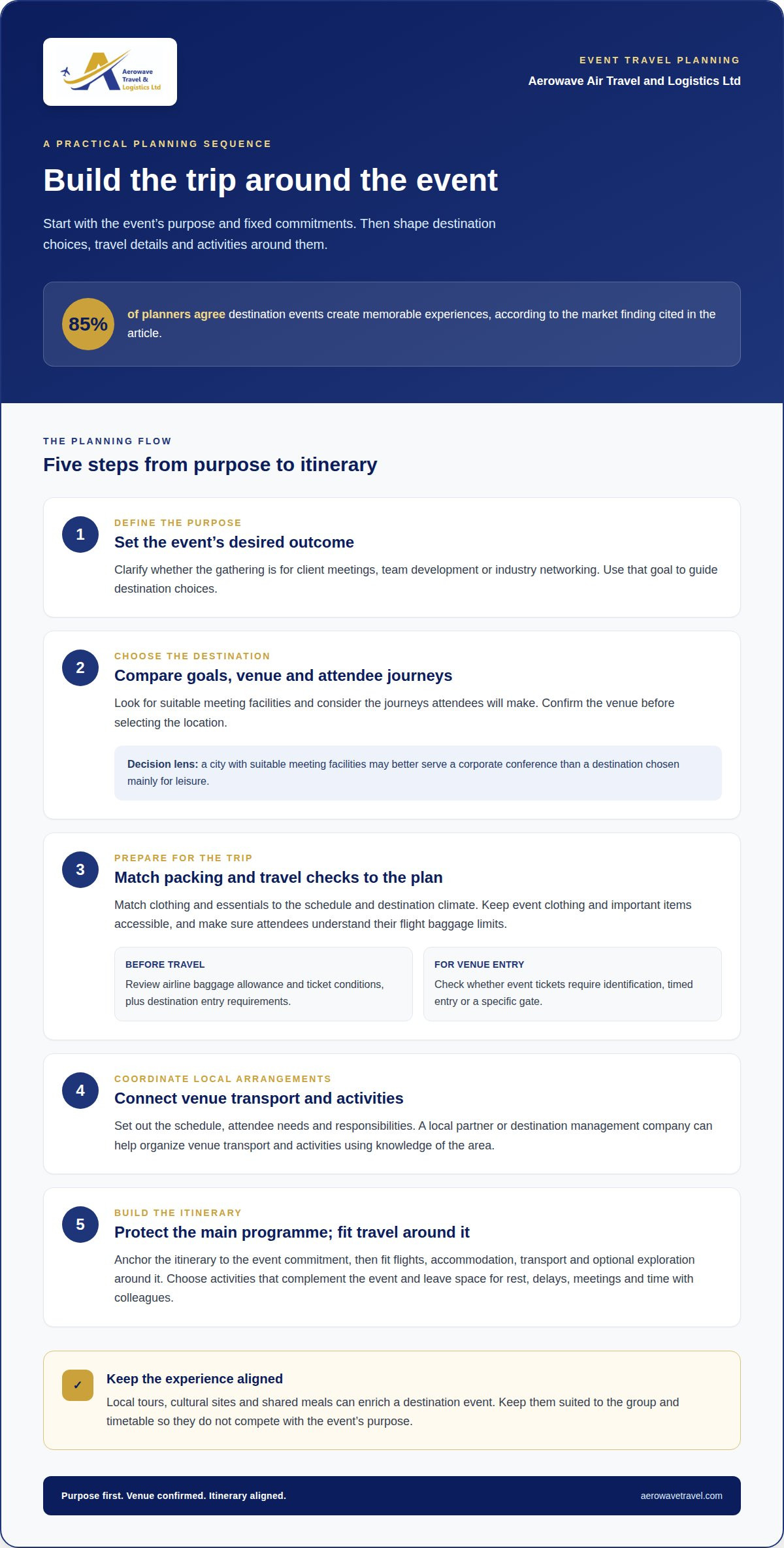
Start by defining what the event needs to achieve, such as client meetings, team development, or industry networking. Compare destinations against those goals, the venue location, and the journeys attendees will make. A city with suitable meeting facilities may work better for a corporate conference than a destination chosen mainly for leisure. Confirm the venue before selecting the location.
-
Pack for the Event and Destination
Match each attendee’s packing list to the schedule and destination climate. A conference may call for formal attire, while a festival may require comfortable footwear. Travel adapters and personal essentials can also be useful. Keep event clothing and important items accessible during the journey, and make sure everyone understands the baggage limits for their flights.
- Plan local arrangements before confirming the itinerary. A local partner or destination management company can help organize venue transport and activities using knowledge of the area. First, set out the event schedule, attendee needs, and responsibilities. A clear brief helps connect local arrangements with the wider travel plan.
- Choose destination activities that complement the event rather than compete with it. Attendees may enjoy a local tour, cultural site, or shared meal, but a crowded itinerary leaves little room for rest or delays. Select activities that suit the group and the event timetable. Leave space around the main programme for meetings and time with colleagues.
- Build the itinerary around the event commitment, then fit flights, accommodation, transport, and optional exploration around it. Destination events can create memorable experiences: 85% of planners agree they do, according to the market finding provided for this topic. Treat that experience as part of the event’s purpose, not a reason to overload the schedule. Keep travel choices aligned with the outcomes organizers want attendees to take home.
How can I ensure the safety and security of my attendees?
In Kenya, share clear venue and accommodation details, agree on transport arrangements, and keep event tickets accessible. For international attendees, send practical arrival information before travel and provide a clear contact point for event-day questions.
-
Track Attendee Bookings and Travel Changes
Keep one secure itinerary for each attendee, with flight details, arrival times, accommodation, and planned transfers. Record changes promptly and share relevant updates with the people coordinating arrivals and the event schedule. If a flight booking changes, review the effect on transfers and meeting times. Avoid scattered email threads where updated arrival details can be missed.
-
Address Accessibility, Timing, and Attendee Needs
Collect travel requirements early, including mobility support, dietary needs, and preferred communication methods. Use these details to plan suitable transfers, accessible routes, and enough time between arrival and event commitments. Build the schedule around actual arrival windows rather than assuming everyone will reach the venue together. A clear plan helps organizers respond to delays or requests for additional assistance.
-
Communicate Travel Details to Attendees
Send each attendee a concise travel brief with confirmed booking details, pickup instructions, accommodation information, venue access points, and an event contact. Keep the same details in an accessible digital location and provide a backup copy of tickets. Ask attendees to download the event app and locate their tickets before arrival, as mobile signal may be patchy at the venue. Explain how you will share updates if plans change.
- Set a safety plan for movement between the airport, accommodation, venue, and any optional activities. Share agreed pickup locations and departure instructions, and make sure attendees know how to reach the event coordinator. For a destination event, dedicated on-site support staff should be available 24/7. Keep local exploration optional and clearly scheduled, so attendees can join a tour or meal without missing key sessions.
Leave breathing room around event commitments. Attendees can explore local attractions, dining experiences, or cultural sites, but a packed schedule can add fatigue and make group coordination harder. Choose activities that fit the event timetable, then communicate meeting points and return arrangements. For help organizing coordinated group travel arrangements, keep flights and airport transfers connected to the event schedule.
Choosing a hotel for venue and transport access
Choose the venue and hotel together, then plan transport around the event schedule. Venue travel options may include parking, shuttles, public transport, or drop-off access. Base attendee instructions on the arrangements available at that venue.
-
Plan Around Fixed Dates and Venues
Confirm the event dates and venue before arranging accommodation or transport. A fixed conference schedule leaves less room to change arrival plans, so compare the venue’s location with attendee routes and meeting times. Major concerts and festivals can increase demand for flights and hotels in the host city. Build the travel schedule around the event, not a preferred hotel alone.
Choose a location that supports the event’s purpose. A corporate meeting may benefit from convenient access to the venue and business facilities, while a multi-day conference may need accommodation that makes daily transfers manageable. Avoid splitting the group across distant locations unless the programme requires it.
-
Choose Accommodation Near the Venue
Prioritize hotels near the venue or on a direct transport route, then weigh comfort against practical access. Book early for major event dates, when nearby options may face greater demand. A central location can simplify arrivals, but proximity alone is not enough. Consider late-night transport, taxi access, walking routes, and the journey back after sessions.
Allow extra time for departures. Leaving a crowded venue and reaching a hotel can take longer than the programme’s finish time suggests. For a major concert, match, or festival, arriving in the host destination the day before can make the trip less rushed. Compare the full journey, including transfers, rather than judging a hotel by map distance alone.
-
Check Venue Travel, Parking, and Shuttle Options
Review the venue’s access arrangements and turn them into clear travel instructions. Identify available parking, shuttle routes, public transport connections, and designated drop-off points. If the venue operates a shuttle, share its pickup location and schedule with guests before the event. Do not assume a nearby hotel provides transport or that parking suits every attendee.
For evening events, plan the return journey as carefully as arrival. Tell attendees where to meet their transport after the programme and allow time for the group to leave together. A direct transport route or nearby hotel can simplify the journey, while an extra night may make a late departure easier.
-
Coordinate Venue, Catering, Guests, and Speakers
Coordinate venue access with the event schedule, catering, and guest arrivals. Share the same timetable with the venue team, speakers, and the person coordinating attendee transport. If a keynote speaker arrives shortly before a conference session, for example, arrange pickup and venue entry around the programme rather than treating them as separate tasks.
Confirm where catering is served and how guests move between meeting rooms, dining areas, and transport points. This helps prevent meals or sessions from conflicting with a shuttle departure or speaker arrival. Keep the final schedule consistent across guest instructions and venue coordination.
Comparing group rates and flexible booking terms
Cancellation and refund terms depend on each ticket, hotel, and transport booking. Before paying, review deadlines, change fees, and refundable amounts. Plan in sequence: confirm attendees, set booking deadlines, compare group terms, reserve accommodation and travel, then track changes against the event budget.
-
Set Group Booking Deadlines
Set an internal deadline for attendee details before the booking deadline, then allow time to resolve missing information. Group travel for 10 or more people often secures better rates and flexibility. Compare the full conditions, including payment dates, name changes, cancellation windows, and how long quoted terms remain available. Avoid treating a group rate as flexible until its booking conditions say so.
- Compare the total group cost, not only the headline fare or room rate. Include accommodation, flights, ground transport, meals, and event-related transfers in one working budget. For destination event budgets, a 10-15% contingency fund is advised. Use it to plan for unexpected changes rather than committing the full budget to initial bookings.
Separate fixed costs from costs that depend on final attendee numbers. A room block may have a release date for unused rooms, while group transport may depend on confirmed arrival times. Record these conditions beside the relevant budget items so organizers can see the financial effect before changing the schedule.
-
Arrange Group Air and Ground Transportation
Coordinate flight bookings with the event dates and the group’s arrival pattern. Compare options for attendees travelling together with separate itineraries, since arrival times affect airport transfers and check-in. Match ground transport to confirmed flight details, venue timings, and luggage needs. Keep a shared record of booking references and changes, and never arrange pickups using outdated arrival information.
- Request accommodation terms that suit the group’s room needs and event schedule. Check room types, payment deadlines, cancellation windows, and when unused rooms return to general availability. Compare the room-block terms with individual bookings, including how changes affect the total commitment. Keep preferences separate from confirmed reservations so organizers can see what remains unresolved.
A corporate group arriving on different days, for example, may need a room block that accommodates staggered check-ins. Align room nights with flight details and the meeting programme, then track additions or cancellations against the hotel’s stated deadlines. This helps prevent mismatches between reserved rooms and attendees’ actual plans.
- Keep one booking summary for organizers, listing each supplier’s payment date, change conditions, cancellation deadline, and responsible contact. Update it whenever attendee numbers or travel plans shift. The summary makes the next decision clear: retain the booking, change it within its terms, or release it before the deadline. Share only the details each coordinator needs to manage their part of the group logistics.
Choosing an event and aligning travel plans with its purpose
Choose events for the outcomes they can support, then shape travel around the programme. A clear purpose helps attendees focus their time on the right sessions, people, and experiences.
- Define the desired outcome before selecting an event. For a corporate team, priorities might include client relationships, staff learning, or product exposure, and each goal points to a different programme. List the decisions attendees should be able to make or the connections they should build. Use that list to judge whether the sessions and format justify the travel.
- Match the event format to the group’s needs. A conference with scheduled presentations may suit teams seeking structured learning, while a trade exhibition may better support product demonstrations and client conversations. Review the programme for relevant sessions, speakers, and networking opportunities. Do not choose an event just because its destination appeals if its content does not serve the group’s purpose.
- Choose travel dates that protect the event’s most important moments. If a keynote or client meeting starts early, plan to arrive with enough time to settle beforehand. For an event in Nairobi, align flight arrival with the opening session rather than adding activities that could compete with it. Plan departure around the final commitment, not just the advertised finish.
- Decide how much destination exploration would add to the event. A shared cultural visit or meal can create opportunities for conversation, especially when attendees have time to connect outside formal sessions. Choose activities that suit the group and programme. Leave room for rest and informal discussion instead of filling every open period with excursions.
- Connect the travel schedule to the event’s rhythm. A multi-day conference may call for a different pace from a single-day meeting, while a festival or sporting event may centre on specific performances or fixtures. Mark essential commitments first, then fit arrival, transfers, and optional time around them. This keeps travel purposeful and avoids unnecessary schedule conflicts.
- Give attendees a concise explanation of why the event matters and what they should prioritize. For example, a team attending a client-focused conference can identify relevant sessions and plan time for conversations. Share the main objective alongside the itinerary so each person can make useful choices during the event. Coordinate travel around your event goals to keep the journey connected to the programme.
Aerowave Air Travel and Logistics Ltd: Event Travel Planning
Aerowave Air Travel and Logistics Ltd coordinates event travel planning for groups that need flights and airport transfers arranged around an event schedule. Its Air Ticketing Services and Flight Booking Services help align attendee journeys with arrival times, while Airport Transfers Services connect airport travel with the wider itinerary.
Turn to Aerowave Air Travel and Logistics Ltd when coordinating bookings, arrivals, and event commitments is taking time away from organizing the programme. Share the event dates, destination, attendee travel needs, and key schedule details so the arrangements support the purpose of the trip.
Contact Aerowave Air Travel and Logistics Ltd to discuss your event travel arrangements.
Make the Next Event Easier to Deliver
A well-considered approach to event travel planning can also create a useful foundation for future gatherings. After attendees return, capture what helped the programme run smoothly and where coordination became difficult. Notes on arrival patterns, communication, and schedule changes can guide stronger decisions next time without relying on memory alone.
Use those observations to improve your internal process. Keep the event purpose clear, assign responsibility for travel decisions, and make the latest itinerary easy for coordinators to access. These practices help your team prepare with focus while leaving room to adapt when event needs change.
When arranging flights and airport transfers alongside an event programme requires dedicated coordination, Aerowave Air Travel and Logistics Ltd can support the travel arrangements. Contact Aerowave Air Travel and Logistics Ltd to discuss your group’s plans. With a clear next step, you can move into preparation with confidence and give the event the attention it deserves.
Frequently Asked Questions
What are the advantages of using a specialized destination event planner or DMC?
A destination management company can coordinate local arrangements and help organizers work with services at the event destination. This can be useful when the team is unfamiliar with the area or managing several moving parts. For example, a local coordinator can connect venue timings with ground transport and group activities. The organizer remains responsible for setting event objectives, attendee needs, and decisions that require approval.
What do you know about event and travel planning?
Event and travel planning brings the event’s purpose, attendee journey, and schedule into one coordinated plan. It can cover decisions ranging from which meetings matter most to arranging flights and transfers around them. For a Kenyan organization hosting international guests from Mogadishu, Kigali, Kampala, the United States, the United Kingdom, Canada, or Europe, clear arrival instructions help connect travel with the programme. Aerowave Air Travel and Logistics Ltd coordinates event travel arrangements, including flight bookings and airport transfers.
How far in advance should you book event travel?
Start when the event dates, venue, and key attendee commitments are clear. The right lead time depends on when those details are settled, demand at the destination, and booking flexibility. For a major conference or festival, delaying decisions can narrow accommodation and flight choices. Booking before attendee details are settled can also lead to changes, so align reservations with confirmed plans and booking terms. For trips that include a safari, group travel planning in Kenya can also help organizers compare suitable dates, routes, and group accommodation needs.
What is the average cost of event travel including transport and accommodation?
There is no single average cost for every event trip. For a Kenyan budget, estimate costs in KSh by listing flights or other transport, accommodation, local transfers, meals, and event activities. The total depends on the destination, travel dates, room arrangements, and how attendees get around. Separate essential and optional items, then revise estimates as the itinerary and attendee requirements become clearer.
How do you compare flights, trains, buses, and driving for an event?
Compare options by total journey time, door-to-door convenience, group coordination, luggage needs, and flexibility if plans change. A train or bus may suit a route with convenient station access, while driving can help groups carrying event materials. Flights may suit longer distances, but airport transfers add another stage. Compare the complete trip, including how attendees reach the venue, rather than the ticket alone.
How do you find hotels near an event venue and compare prices?
Search near the venue and along practical transport routes, then compare accommodation for the same event dates and room requirements. Look beyond the displayed rate: check what each booking includes, its cancellation terms, and the journey to the venue. A lower-priced hotel farther away, for example, may mean extra transfers and travel time. Compare the full stay and access arrangements before deciding what suits the group.
How do you plan local transport from the airport or station to an event?
Start with the group’s arrival information and the event’s first commitment. Match pickups to actual flight or train arrival times, and share the agreed meeting point and onward destination with each traveller. For arrivals in Nairobi or Mombasa, organizers can coordinate airport transfers with the venue timetable. Keep a plan for late arrivals and updates so transport arrangements can adapt if journeys change.
What are the risks of traveling for an event and how can you prepare?
Travel disruptions, missed connections, misplaced tickets, and schedule changes can affect attendance. Reduce avoidable confusion by keeping booking details accessible, sharing itinerary updates, and allowing time between arrival and important sessions. International attendees should organize the travel documents and entry arrangements relevant to their destination before departure. Agree on a communication method and meeting point in case group members become separated.