
A complete application depends on your destination and reason for travel, not just a passport and form. Careful travel visa document preparation means gathering the required identity, itinerary, accommodation, financial and purpose-of-visit documents, then checking that your passport meets the destination’s rules. For Kenya’s eTA, processing typically takes three (3) working days, though it may take longer in some cases.
It’s understandable to want a clear checklist and realistic timing before making travel plans. The documents you need depend on your destination and whether you’re travelling for tourism, a family visit or business, so start by matching your evidence to your purpose.
This guide covers common visitor visa documents, passport validity and blank-page requirements, and how to review processing timelines. It also explains how to organise your application and where Aerowave Air Travel and Logistics Ltd’s visa consultancy can help with preparation.
Key Takeaways
- Match supporting documents to your reason for travel, such as tourism, business, a family visit or medical care.
- For a Spain Schengen visa, check that your passport meets the validity, issue-date and blank-page requirements before preparing the application.
- Keep your itinerary, accommodation evidence and financial documents aligned with the details in your application.
- Allow for processing times that vary by destination and application type, and plan around the possibility of additional review.
- Prepare photographs and forms to the specific visa office’s requirements to help avoid preventable application delays.
What Are the Supporting Documents Required for Visitor Visas?
For Kenyan citizens, visitor visa documents depend on the destination, travel purpose and application category. Prepare the destination’s required evidence, then confirm current entry rules before submitting your application.
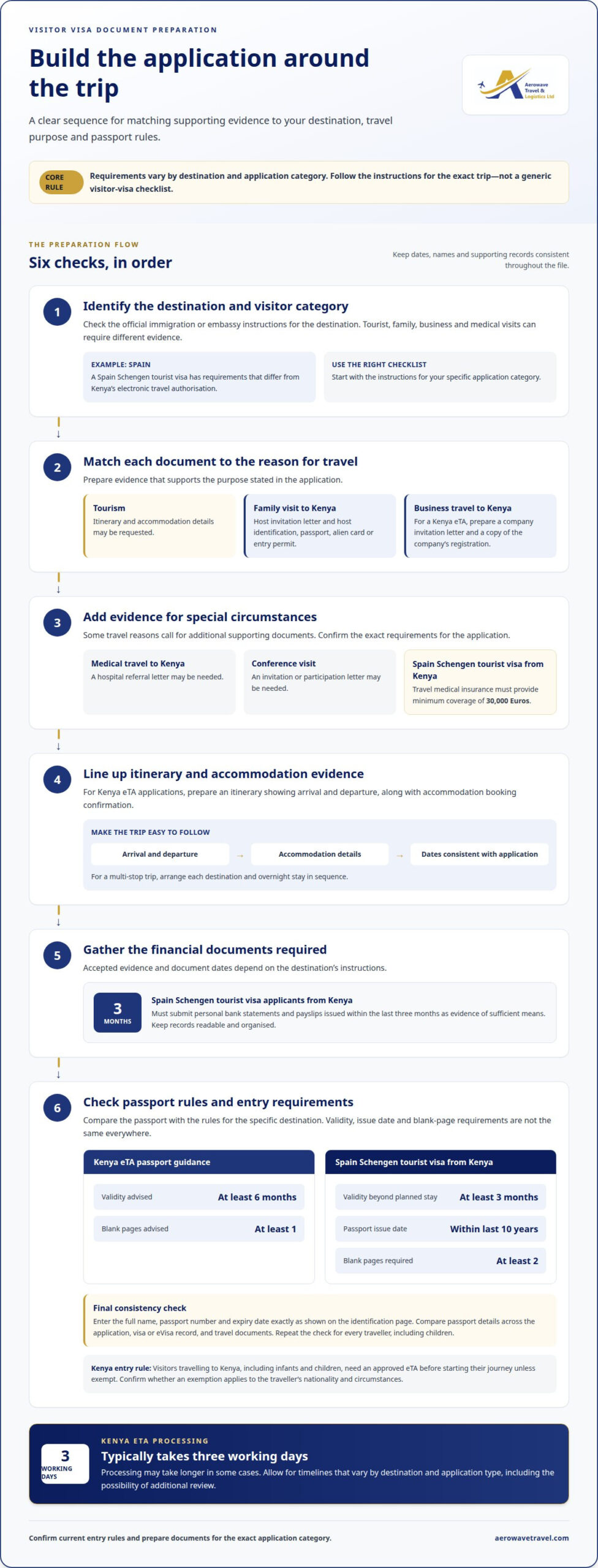
- Identify the destination’s exact visitor category. Check the official immigration or embassy instructions for your destination. Tourist, family, business and medical visits can require different evidence. For example, a Spain Schengen tourist visa has requirements that differ from Kenya’s electronic travel authorisation. Follow the checklist for your specific category rather than relying on a general visitor-visa list.
- Match each document to your travel purpose. A tourism application may request an itinerary and accommodation details. For a family visit to Kenya, prepare an invitation letter from your host and the host’s identification, passport, alien card or entry permit. Business travellers applying for a Kenya eTA should prepare a company invitation letter and a copy of the company’s registration.
- Include supporting evidence for special circumstances. Applicants travelling to Kenya for medical reasons may need a hospital referral letter. Conference visitors may need an invitation or participation letter. For a Spain Schengen tourist visa from Kenya, travel medical insurance must provide minimum coverage of 30,000 Euros, according to the Spanish Ministry of Foreign Affairs, European Union and Cooperation.
- Prepare travel and accommodation evidence where required. Kenya eTA applicants should prepare an itinerary showing arrival and departure, along with accommodation booking confirmation. Keep these details consistent with the purpose and dates stated in the application. For a multi-stop trip, arrange each destination and overnight stay in sequence so the route is easy to follow.
- Gather financial documents for the relevant application. Spain Schengen tourist visa applicants from Kenya must submit personal bank statements and payslips issued within the last three months as evidence of sufficient means. Check the destination’s instructions for accepted evidence and document dates. Make sure records are readable and organised so the financial information is clear.
- Check entry rules before finalising your file. Visitors travelling to Kenya, including infants and children, need an approved eTA before starting their journey unless exempt. Kenya’s eTA requirement includes exemptions for some nationalities and passport holders. Check Kenya visa application guidance for eTA exemptions to confirm whether an exemption applies to the traveller’s nationality and circumstances, then follow the relevant entry instructions.
Passport validity and blank-page requirements
Check the passport and destination requirements together before completing a visa or eVisa application. Validity periods and blank-page requirements vary by destination and travel document.
-
Check passport validity and blank pages
Check the passport’s identification page for its expiry and issue dates. Compare the expiry date with your planned arrival and departure dates. Many countries require a passport to remain valid for six months after planned arrival, but the required period varies.
For Kenya’s eTA, applicants are advised to hold a passport with at least six months of validity and at least one blank page. For a Spain Schengen tourist visa from Kenya, the passport must remain valid for at least three months beyond the planned stay in the Schengen Area, according to the Spanish Ministry of Foreign Affairs, European Union and Cooperation. That ministry also says the passport must have been issued within the last ten years.
Count unused pages before applying. A Spain Schengen application requires at least two blank pages. Don’t assume a page containing stamps or visas counts as blank. If your passport lacks the required validity or available pages, address that before preparing the application. A near-expiry passport can affect visa eligibility and travel plans.
Follow the destination’s rules rather than applying one general rule everywhere. For example, a Spain Schengen visa applicant should compare the passport’s expiry date with the planned end of the Schengen stay. Someone applying for a Kenya eTA should separately review the passport validity and page guidance.
-
Match passport and visa requirements
Use the same passport details throughout the visa application and travel arrangements. Enter the passport number, full name and expiry date exactly as they appear on the identification page. A mismatch between the passport and an eVisa record can complicate document checks, so compare each entry before submitting.
Read the instructions for the exact passport type and destination. Spain Schengen requirements include validity and issue-date conditions, while Kenya eTA guidance has its own passport advice. A valid passport alone doesn’t replace a visa or eTA when required. Similarly, an approved visa doesn’t remove passport conditions.
If you renew your passport after applying for an eVisa, don’t assume the approval transfers automatically. Follow the issuing authority’s instructions for updating the application or linking a new passport. Keep the application record and travel document details together, and use the passport associated with the approval as directed.
Before finalising the file, compare passport details across the application, visa or eVisa record, and travel documents. Check spelling, document number and expiry date. For a family trip, repeat the check for every traveller, including children. Each passport has its own identity details and potentially a different validity date.
Confirm the destination’s current rules before submission. A transit stop or itinerary change can affect which entry documents apply. Check requirements for each destination and transfer point, and keep the relevant passport and visa records accessible during travel.
Application processing time
Visa fees depend on destination, visa category and application route, so use the relevant official instructions for payment details. Processing times and appointment requirements also vary; Kenya eTA applications typically take three (3) working days, while Spain Schengen decisions can take longer.
- Set your timeline around the destination’s stated processing period. For Kenya eTA applications, processing typically takes three (3) working days, though some cases take longer. Treat this as a typical estimate, not a guaranteed completion date. Build your plans around the possibility of a longer wait, especially before arranging travel that depends on an approved eTA.
- Use the correct timeframe for a Spain Schengen application. The legal decision period for a Spain Schengen visa application from Kenya is 15 calendar days and can be extended to 45 calendar days. Calendar days include weekends, unlike working days. Keep this distinction in mind when planning, and avoid using the Kenya eTA timeframe to estimate a Schengen decision.
- Check appointment instructions before setting travel dates. Appointment requirements depend on the destination and application route. Review the official instructions to see whether an appointment is required and how to arrange it. Include appointment availability in your planning, as the application timeline may involve more than waiting for a decision.
- Confirm fees and payment steps from the applicable instructions. Visa fees vary by destination, category and application route, so don’t assume one country’s fee applies elsewhere. Check the official instructions for the amount, accepted payment method and payment deadline. Keep any payment record with your application details in case you need it later.
- Plan for the full process, not only the stated decision period. Allow time to arrange an appointment, submit the application and receive the outcome. A Kenya eTA may take longer than its typical three-working-day processing time, and a Spain Schengen decision period may extend to 45 calendar days. Avoid making non-refundable travel arrangements based only on the shortest timeframe.
- Review your timeline when the itinerary changes. A new departure date, destination or transfer point can change which application instructions apply. Recheck processing and appointment details before changing bookings. For example, someone combining a Kenya eTA application with a Spain Schengen application should plan for each process separately.
Common visitor visa supporting documents
Build your file around the destination’s checklist and your reason for travel. Requirements vary, so organise evidence by category and confirm the required format for each document.
-
Gather financial documents
Collect the financial evidence named in the destination’s instructions, such as personal bank statements and payslips. For a Spain Schengen tourist visa from Kenya, applicants must submit these documents issued within the last three months. The required funds depend on the destination and planned stay, so follow the applicable instructions for the amount.
For Spain, organise financial records so the available funds and trip plans are clear. Keep statements readable and ensure they cover the period required for the application. Careful travel visa document preparation means presenting relevant records together, rather than adding unexplained documents that don’t support the stated visit.
- Align accommodation, transport and insurance evidence. Kenya eTA applicants should prepare accommodation booking confirmation and an itinerary showing arrival and departure. Other destinations may request different travel evidence, so follow their checklist rather than assuming every visa requires the same bookings. Keep dates consistent across the itinerary, accommodation records and application.
For a multi-stop trip, arrange each destination and overnight stay in sequence. This makes your planned route easier to understand and shows how the supporting records relate to the visit.
-
Prepare document certifications and translations
Check the destination’s instructions for document language, certified translations, notarisation and apostille requirements. These vary by authority and document type, so don’t arrange certification automatically. If a translation is required, submit the original document with its translation in the specified format.
Compare names, dates and other key details across both versions. For example, check that the identity details in a translated employment letter match the passport before including it.
-
Document employment, studies, and home ties
Choose evidence that explains your current responsibilities and planned return. Depending on your circumstances and the application checklist, this may include an employer letter, approved leave details or proof of current studies. Self-employed applicants can organise relevant business records that support their work and travel plans.
Match each document to your circumstances. A student’s enrolment evidence serves a different purpose from an employee’s leave letter, so avoid including unrelated papers without explanation.
-
Review documents for common mistakes
Compare each document with the application for matching names, dates and travel details. Missing pages, inconsistent dates, unreadable scans, expired evidence or financial records outside the required period can weaken an application. For Spain Schengen applications, check that bank statements and payslips were issued within the required three-month period.
Use the destination’s checklist for your final review. Confirm that every requested item is present, legible and correctly prepared before submission. Strong travel visa document preparation also means following instructions for documents that don’t apply, rather than leaving a required field unexplained. For more guidance on how to avoid mistakes in visa applications in Kenya, review the Kenya eTA document checklist and check that your details are consistent.
How do I prepare a valid passport, photos, and visa application form?
Prepare these three parts as one coordinated file: the passport establishes identity, photographs must meet destination specifications, and the form records trip details. Follow the relevant visa office’s instructions for each requirement.
- Set aside the passport you’ll use for travel. Check its identification page and use those details throughout the application. Enter your name, passport number, nationality and expiry date exactly as printed. Review each entry before submission, especially if your name includes several parts or punctuation. Keep a clear copy of the identification page with your application records, and make sure the submitted passport is the one associated with the visa or eVisa application.
- Check whether earlier passport records are needed. Some applications ask for previous passports or visa history as supporting evidence. For a Spain Schengen tourist visa from Kenya, applicants whose current passport was issued within the last 3 years should provide the original and a copy of their previous passport. Applicants should also provide copies of previous UK, US, Canada, Australia and Schengen visas from the last 3 years. Arrange these records in date order so the travel history is easy to follow.
- Prepare photographs to the destination’s exact specifications. Visitor visa applications commonly request one or two photographs in a size specified by the visa office. For a Spain Schengen tourist visa from Kenya, the colour photograph must measure 45 mm x 35 mm and be no more than six months old. Confirm the required size, colour and recency for your destination before taking or submitting a photograph. Don’t assume one photo format works for every visa.
- Complete the application form using your supporting records. Use your passport and itinerary to enter identity and travel details accurately. Keep arrival dates, accommodation details and the stated purpose of travel consistent across the form and supporting documents. Review every required field before submission. If a question doesn’t apply, follow the form’s instructions rather than leaving it unanswered without explanation.
- Make a final document-to-form comparison. Read the completed form beside the passport, photograph requirements and supporting records. Check spelling, passport details, dates and the selected visa category. For a family application, review each traveller’s form and photograph individually, including those for children. Keep originals and copies organised according to the submission instructions. If you want support coordinating these preparation steps with Aerowave Air Travel and Logistics Ltd, get help organising your visa application documents.
Aerowave Air Travel and Logistics: Visa Consultancy Services
Aerowave Air Travel and Logistics Ltd provides Visa Consultancy Services to help travellers organise application requirements and supporting documents. This can be useful when destination-specific rules, forms or document lists are difficult to coordinate. Visa consultancy supports application preparation; it doesn’t issue visas, and the relevant authorities decide applications.
To coordinate travel arrangements alongside your application, Aerowave Air Travel and Logistics Ltd also offers Flight Booking Services, Air Ticketing Services and Airport Transfers Services. These services can help organise the journey around your itinerary.
If you’re ready to organise your visa application and travel plans, contact Aerowave Air Travel and Logistics.
Move from preparation to a well-planned trip
Use application preparation as the starting point for a coordinated journey. Once your documents are organised, keep your travel arrangements aligned with the itinerary and purpose stated in your application. Careful travel visa document preparation can help you move from planning to departure with greater confidence, while the relevant immigration authority remains responsible for visa decisions.
Aerowave Air Travel and Logistics Ltd can coordinate the travel arrangements around your application through Air Ticketing Services, Flight Booking Services and Airport Transfers Services. Organising these details alongside your plans can help keep the journey on track, from booking flights to arranging airport transport.
For assistance with your travel plans, contact Aerowave Air Travel and Logistics. Take the next step at a pace that suits your plans, with the details organised before departure.
Frequently Asked Questions
What Documents Do You Need When Traveling to Another Country?
Carry a valid passport and any visa or electronic travel authorisation required for your destination. Keep your itinerary, accommodation details and application approval accessible during the journey, including at transfer points. For example, a Kenyan traveller connecting through another country should check that location’s transit requirements as well as the final destination’s entry rules. Store digital copies separately from originals so key details are easy to retrieve.
What Is a Visa?
A visa is an official authorisation from a destination’s government that allows a traveller to seek entry, transit or a particular type of stay. Its conditions depend on the issuing country and visa category. For example, visitor and business visas can serve different travel purposes. Read the visa conditions and make sure your planned activities match the category granted.
What Is an eVisa?
An eVisa is a visa processed through an electronic application system rather than a paper-only process. Applicants submit information digitally, and the issuing authority communicates the outcome electronically. The steps vary by destination. Kenya’s eTA is an electronic travel authorisation, so follow the relevant application instructions and keep the approval details with the passport used for the application.
What documents are required for a travel visa application?
Requirements depend on the destination and visa category, but applications commonly request identity details, a completed form, photographs and evidence supporting the purpose of travel. Authorities may also ask for additional documents based on an applicant’s circumstances. Use the destination’s checklist to group papers by identity, travel, finances and purpose. This makes it easier to spot missing items and find supporting evidence during submission.
How do visa document requirements vary by destination and visa type?
Each destination sets its own application process, and each visa category relates to a different purpose of travel. A tourist application may focus on the proposed visit, while a business application may require evidence explaining the work-related purpose. A family visit may call for information about the host. Check the instructions for the exact destination and category, as document formats, submission methods and supporting evidence can differ.