
Not every traveller needs an eTA to enter Kenya: some nationalities and status groups are exempt, and the permitted stay depends on the category. Clear visa application guidance in Kenya starts with checking whether an exemption applies before preparing an application.
A passport and travel plans may not be enough: the supporting documents depend on your circumstances and purpose of travel. This guide explains who may be exempt from Kenya’s eTA, what to prepare, where to apply, and which issues can put an application at risk of refusal.
You’ll also find practical ways to keep an application consistent, from passport details to travel arrangements. Whether you’re planning a visit to Kenya or applying for permission to travel abroad from Kenya, understanding the requirements early makes the process clearer and easier to manage.
Key Takeaways
- Determine whether your nationality or status qualifies for an eTA exemption before preparing an application.
- Match supporting documents to your travel purpose, and keep the details consistent across your application.
- Understand where applications are submitted and how private visa consultancy can help organize the process.
- Review passport validity and blank-page requirements early to avoid a preventable application issue.
- Learn which common application weaknesses can contribute to a visa refusal and how careful preparation can address them.
Additional documents by travel purpose
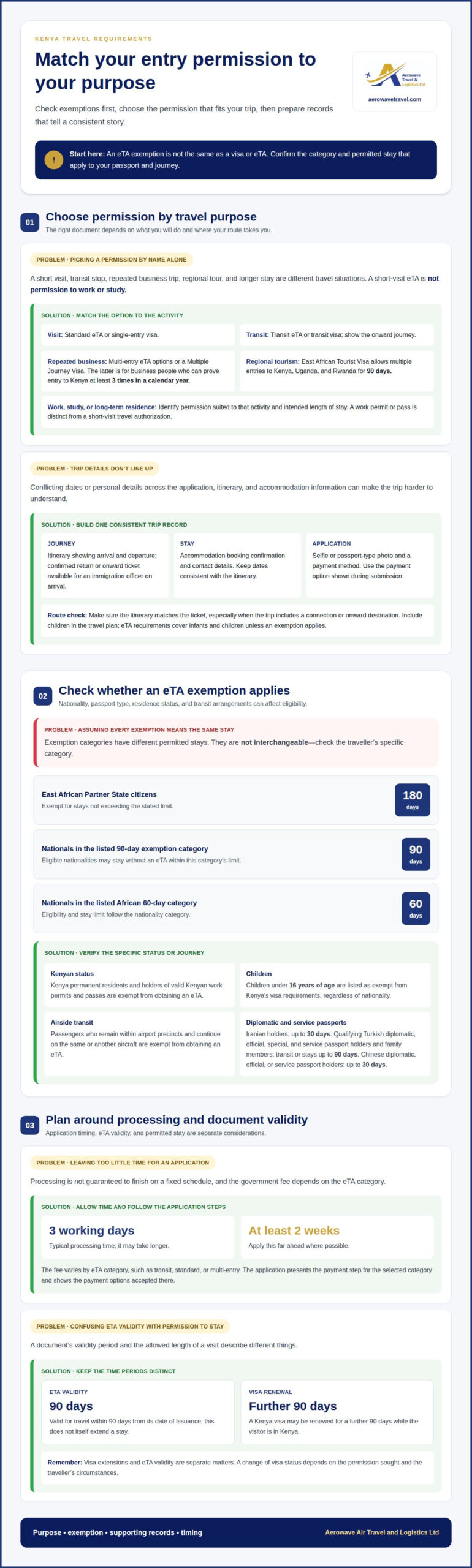
Travel purpose determines which Kenyan entry permission and supporting records fit your plans. Options include a standard eTA for visits, a transit eTA, and multi-entry eTAs. Other options include a single-entry visa, a transit visa, a Multiple Journey Visa, and the East African Tourist Visa for regional tourism. These are different travel permissions, so choose based on your activities and route.
For work, study, business, or long-term residence, how do you apply for a Kenya visa? First, identify the permission that matches your purpose, then prepare evidence to support that activity and submit the relevant application. A short-visit eTA is not permission to work or study. Kenya permanent residents and holders of valid Kenyan work permits and passes are exempt from obtaining an eTA.
For an eTA application, gather the key travel records before submitting. Applicants should provide an itinerary showing arrival and departure, accommodation booking confirmation, contact details, a selfie or passport-type photo, and a payment method. These details link the application to a specific trip. Keep the dates and personal details consistent across the itinerary and accommodation information.
Additional records depend on the reason for travel:
- Tourism: Prepare accommodation confirmation and trip dates. For regional tourism, the East African Tourist Visa described allows multiple entries to Kenya, Uganda, and Rwanda for 90 days.
- Transit: Show the onward journey and explain how the Kenya stop fits the route. Passengers staying within the airport precincts and continuing on the same or another aircraft are exempt from obtaining an eTA.
- Business: Include records that make the business purpose and planned visit clear. A Multiple Journey Visa is for business people who can prove entry to Kenya at least 3 times in a calendar year.
- Work or study: Organize documents around the activity and intended length of stay. A work permit or pass is distinct from a short-visit travel authorization.
For visits, have a confirmed return or onward ticket available to show an immigration officer on arrival. The itinerary should match the ticket, particularly if the route includes a connection or onward destination. If a child is travelling, include them in the travel plan. eTA requirements apply to visitors, including infants and children, unless an exemption applies.
What visa types are available for travel to Kenya? Short visits may require a standard eTA or single-entry visa; transit and repeated journeys have separate options, while the East African Tourist Visa covers regional tourism. Work, study, and long-term residence require permission suited to those purposes. Organizing records by purpose helps distinguish visitor trip evidence from documents supporting a longer stay.
Kenya eTA exemptions by nationality and status
Kenya’s eTA exemption depends on nationality, passport type, residence status, and transit arrangements. The broader exemption structure was introduced under amended rules in 2025. Check which category applies before treating an exemption as permission to travel, since each category has its own permitted stay.
Citizens of East African Partner States are exempt from the eTA requirement for stays not exceeding 180 days. Nationals in the listed 90-day exemption category may stay up to 90 days without an eTA. Nationals in the listed African 60-day category may stay up to 60 days. These periods are not interchangeable; eligibility follows the traveller’s nationality and category.
- Diplomatic and service passports: Holders from Iran are exempt for stays not exceeding 30 days. Specific diplomatic, official, special, and service passport holders from Turkey, plus qualifying family members, are exempt for transit or stays not exceeding 90 days. China’s diplomatic, official, or service passport holders are exempt for stays not exceeding 30 days.
- Kenyan status: Kenya permanent residents and holders of valid Kenyan work permits and passes are exempt from obtaining an eTA.
- Children: Children under 16 years of age are listed as exempt from Kenya’s visa requirements, regardless of nationality. The general eTA rule covers infants and children unless an exemption applies.
- Airside transit: Passengers who remain within airport precincts and arrive and leave on the same aircraft, or transfer to another aircraft, are exempt from obtaining an eTA.
Are there special Kenya entry rules for children, transit passengers, or East African Community citizens? Yes. Children under 16, qualifying transit passengers, and citizens covered by East African Partner State exemptions have specific exemptions. Confirm the applicable category against the traveller’s passport and journey details.
The Kenya eTA government fee depends on the category, such as transit, standard, or multi-entry. The application presents a payment step during submission; use an option accepted there. Processing typically takes three working days but may take longer. Where possible, apply at least two weeks before travel.
How much does a Kenya eTA cost, and what payment methods are accepted? The fee varies by eTA category, and the application shows the payment step for the selected category. Use one of the payment options offered there.
Visa extensions and eTA validity are separate matters. A Kenya visa may be renewed for a further 90 days while the visitor is in Kenya. An eTA is valid for travel within 90 days from its date of issuance; that validity period does not itself extend a stay. Changing visa status depends on the permission sought and the traveller’s circumstances.
For exemptions, processing, and stay extensions, distinguish the travel document from the permission governing the visit. Visa application guidance can help organize the application details around the traveller’s purpose.
Official application sources and private assistance disclosure
Use the official application channel for the travel permission you need. For a Kenya eTA, apply through Kenya’s official eTA process. Private assistance can help organize information, but it does not replace official submission or determine the decision. Reliable visa application guidance in Kenya starts with knowing which steps belong to the traveller and which are handled by the government authority.
How do you apply for a Kenya eTA, and what are the official steps? Select the appropriate eTA category, enter the requested traveller and trip details, attach the required documents, then submit the application and payment. Make sure the application matches the passport and itinerary you intend to use for travel.
- Choose the category: Identify whether the journey requires a standard, transit, or multi-entry eTA. A traveller connecting through Kenya has different trip details from someone visiting for tourism.
- Prepare the information: Gather the itinerary showing arrival and departure, accommodation booking confirmation, contact details, and a selfie or passport-type photo. Keep names and dates consistent with the passport and booking records.
- Submit through the official process: Complete the requested fields, provide the documents, and use a payment method accepted during the payment step. Retain the application confirmation and decision for the journey.
Kenya’s general information recommends applying at least two weeks before travel where possible. Processing typically takes three working days, although some applications take longer. Applying early leaves time to respond to a request for further information or accommodate a delay. Visa application guidance in Kenya can help clarify how the official steps relate to your itinerary and supporting records.
Private visa assistance is separate from government processing. A consultant can help organize documents, review application details, and explain procedural requirements. A consultant does not issue a Kenya eTA or decide whether it will be approved. The relevant authority assesses the application, while an immigration officer determines admissibility at the point of entry.
For another destination, follow that destination’s official application instructions. For example, UK visa applications from Kenya are processed through VFS Global in Nairobi at Lenana Road, Hurlingham. That location applies to UK applications, not Kenya eTAs. Keep destination procedures separate because application channels and supporting-document requirements depend on where you plan to travel. Clear visa application guidance in Kenya helps distinguish government requirements from private administrative support.
Before submitting, compare the application with your trip records. Check that passport details, dates, accommodation information, and contact details match. Save copies of the submitted information, payment confirmation, and decision notice so you can refer to consistent records during the journey.
Passport validity and blank-page requirements
For a single-entry Kenya visa, the applicant must have an original passport valid for at least 6 months. Kenya eTA applicants need at least one blank passport page. These are separate checks: one concerns passport validity for a visa application, while the other concerns available space for an eTA applicant.
Review your passport early, before arranging travel documents around an outdated or nearly full booklet. Note the expiry date and check how many pages are available. A passport may meet the six-month validity requirement but have no blank page. Conversely, a blank page does not replace the validity requirement for a single-entry visa.
- Single-entry visa: Prepare the original passport and make sure it remains valid for at least 6 months.
- Kenya eTA: Ensure the passport has at least one blank page.
- Both application types: Enter the passport details exactly as they appear in the travel document.
Use the same passport for the application and travel. If the application refers to one passport but you prepare another, the records may not match. Keep the name spelling, passport number, and personal details consistent across the application and related travel records.
To prepare, open your passport and check the photo and information page, expiry date, and remaining pages. Then compare the information page with the details you plan to enter. For a Kenya eTA, identify a blank page rather than assuming a partly used page meets the requirement. For a single-entry visa, confirm the six-month validity period before proceeding.
Passport condition also matters. A damaged information page can make printed details difficult to read, while a detached or altered page can raise questions about the document. Keep your passport intact and legible. This does not replace the stated validity and blank-page requirements, but helps ensure the document can be read alongside the application.
For family travel, check each traveller’s passport individually. A child’s passport has its own expiry date and page availability, even when the child travels with a parent. Do not assume that checking one adult’s passport covers accompanying children. Apply the relevant document requirements to each passport in the travel arrangements.
Before submitting, make a final comparison: check passport details against the application, the expiry date against the six-month rule for a single-entry visa, and page availability against the one-blank-page requirement for an eTA. Keep these checks distinct. A valid passport is not necessarily a passport with an available blank page, and separating the checks helps prevent avoidable paperwork errors.
Visa rejection reasons for Kenyan applicants
A refusal may reflect a gap between the application’s stated purpose and its supporting evidence. If you are applying from Kenya for a visitor visa abroad, review the account presented by the form, financial records, itinerary, and interview answers. A document can be genuine yet still leave important questions unanswered.
Common weaknesses include an unclear travel purpose, unexplained funding, inconsistent dates, and missing supporting records. For example, an itinerary for a short visit may conflict with an application suggesting a longer stay. A bank statement may show funds without explaining how you will meet trip costs. These gaps can make an application harder to assess.
- Purpose and plans: Describe the visit clearly. Align planned activities, dates, accommodation, and any invitation with the visa category.
- Financial evidence: Present records that explain how the trip will be funded. If another person is paying, make that arrangement clear and support it with relevant documents.
- Consistency: Use matching names, dates, employment details, and travel plans across forms and documents. Explain genuine changes rather than leaving conflicting information unaddressed.
- Personal circumstances: Provide relevant evidence about work, study, family, or other commitments in Kenya when the destination’s application requires it. Avoid unsupported claims.
- Application completeness: Follow the destination’s document list and answer every required question accurately. Missing forms or unclear scans can create avoidable processing issues.
Rates vary by destination and visa type. The reported UK visitor visa refusal rate for Kenyan applicants is 24%, while the US B1/B2 tourist visa refusal rate is more than 35%. These figures describe different application systems; they don’t predict an individual decision.
What should you do if a Kenya visa or eTA application is delayed or refused? If it is delayed, review the status and respond to any request through the relevant official process. If it is refused, read the decision carefully, address its stated concerns, and follow the destination’s instructions before applying again.
For a delayed overseas application, account for the destination’s processing timeline. UK Standard Visitor applications usually take 3 weeks, while standard Schengen processing takes 15 calendar days. Appointment waits or requests for further documents can affect travel planning, so avoid relying on an unissued visa for fixed departure plans.
Before reapplying, compare the refusal reasons with your new evidence. If the concern involved funding, explain the source and availability of the funds. If details conflicted, correct them and provide a coherent account. Repeating the same application without addressing the stated issue may leave the original concern unresolved.
For a careful review of travel documents and application details, request visa application assistance.
Aerowave Air Travel and Logistics: Visa Consultancy Services
Aerowave Air Travel and Logistics Ltd helps travellers organize visa applications through its Visa Consultancy Services. Turn to the team for help understanding document requirements, aligning trip details, or preparing an application for submission. Visa consultancy provides application assistance, not visa issuance; the relevant government authority makes the decision. Flight Booking Services and Airport Transfers Services can also help coordinate your travel arrangements alongside application preparation. Keeping your travel plans and application details aligned makes the process easier to manage, especially when dates or connections matter. For support with your visa application and travel planning, contact Aerowave Air Travel and Logistics Ltd.
Prepare for your next journey with confidence
Make your next step a clear travel plan that connects your application, bookings, and departure arrangements. Strong visa application guidance in Kenya helps you organize these details around your purpose of travel while keeping your plans and documents in view.
Aerowave Air Travel and Logistics Ltd supports the process through Visa Consultancy Services, with Air Ticketing Services, Flight Booking Services, and Airport Transfers Services for related travel arrangements. This can help coordinate application preparation and journey logistics in one place, without confusing travel assistance with the government’s visa decision.
Contact Aerowave Air Travel and Logistics to discuss support for your application and travel plans. With a well-organized next step, you can move ahead with greater clarity and focus.
Frequently Asked Questions
Kenya eTA exemptions: who may not need to apply?
Exemptions cover specified nationalities and traveller statuses, so check the traveller’s category rather than relying only on the trip purpose. East African Partner State citizens may be exempt for stays up to 180 days; other listed categories allow stays up to 90 or 60 days. Kenyan permanent residents and holders of valid Kenyan work permits or passes are also exempt. Qualifying airside transit passengers and some diplomatic passport holders have separate exemptions.
Who needs a visa or eTA to enter Kenya, and which travelers are exempt?
Visitors generally need an approved eTA before starting their journey unless an exemption applies. This includes infants and children who do not qualify for an exemption. The requirement depends on nationality, status, passport type, and transit arrangements. For example, a traveller changing aircraft without leaving the airport precincts may qualify for the transit exemption. Check the traveller’s category before departure, since exemption periods and conditions differ.
What documents are required for a Kenya visa or eTA application?
For an eTA application, prepare the traveller’s trip itinerary, accommodation booking confirmation, contact details, a selfie or passport-type photo, and a payment method. The itinerary should reflect the actual arrival and departure plans. Additional supporting records depend on the purpose of travel. For instance, a business visit needs documents that explain the business purpose, while a transit application should show how Kenya fits the onward route.
What are the passport validity and entry requirements for Kenya?
A single-entry Kenya visa applicant needs an original passport valid for at least six months, while an eTA applicant needs at least one blank passport page. Keep the passport details consistent across the application and travel documents. Visitors should also have a confirmed return or onward ticket available to show an immigration officer on arrival. An approved eTA permits travel, but an immigration officer determines admissibility at the point of entry.
How much does a Kenya eTA cost, and what payment methods are accepted?
The base government fee is US$20 for a Transit eTA, US$30 for a Standard eTA, and US$300 for a One Year Multi-Entry eTA. The accepted payment methods are those offered during the application’s payment step.