
Air cargo from the UK to Nairobi is estimated to take 3-5 working days, but the weight used to calculate your charge may be higher than the parcel’s actual weight. For air cargo services in Kenya, carriers generally bill whichever is greater: actual weight or volumetric weight, calculated by multiplying the parcel’s length, width and height in centimetres, then dividing by 6,000.
That distinction matters because a light, bulky shipment can cost more to send than its scale weight suggests. Understanding how chargeable weight is calculated helps you plan your shipment and make sense of factors that affect its price and delivery time.
This guide explains chargeable weight with a practical example, outlines factors that can affect UK-to-Kenya air cargo prices and transit times, and describes how freight forwarding coordinates goods and supporting documents. It also covers the information that helps prepare a shipment for smoother handling.
Key Takeaways
- Air cargo from the UK to Nairobi is estimated to take 3-5 working days, while clearance and shipment details can affect the overall timeline.
- To estimate chargeable weight, compare the parcel’s actual weight with its volumetric weight; the greater figure is generally used.
- Freight forwarding coordinates transport and shipment documents, helping connect the different steps between dispatch and arrival.
- Shipping costs depend on factors such as chargeable weight, parcel dimensions and the services involved, so understanding the calculation helps with planning.
- Jomo Kenyatta International Airport in Nairobi and Moi International Airport in Mombasa are major gateways for air freight in Kenya.
How Long Does Air Cargo from the UK to Kenya Take?
Air cargo from the UK to Nairobi is estimated to take 3-5 working days. That estimate covers air transit, but customs processing and delivery arrangements also shape the shipment’s full journey. Cargo may reach the airport before it is ready for collection or onward delivery. Plan separately for flight transit, cargo release, and the final delivery leg. This distinction helps set realistic expectations for air cargo services in Kenya.
Prepare a commercial invoice, packing list, accurate goods description, and air waybill details for a Kenya-bound shipment. Customs may require other supporting documents, depending on the cargo and clearance requirements. Check that descriptions and quantities match across the paperwork. Consistent information makes the shipment contents easier to identify and supports processing.
Customs handling starts with a review of shipment information and supporting documents. Authorities may assess the goods and determine applicable import duties and taxes. The amount depends on shipment-specific details, including the goods and their declared value. When planning your total budget, keep transport charges separate from import charges.
Clearance timing can vary with document accuracy, the type of goods, and any additional review. If customs requests clarification, a response may be needed before the cargo moves onward. Keep the invoice and packing list accessible, and make sure the person managing the shipment can answer questions about its contents. These steps can help prevent delays caused by missing or inconsistent information.
How can you track air cargo shipments in Kenya? Use the shipment reference or air waybill details to follow available carrier updates and milestones. If the status stops changing, share the reference and latest update with the shipment handler. This helps identify the recorded shipment stage and the next coordination step.
If cargo arrives damaged, record its visible condition and photograph the packaging before moving or discarding it. Notify the carrier or shipment handler promptly, and keep relevant paperwork and delivery records. These details document the cargo’s condition on arrival and support follow-up.
Clearing and forwarding connects transport coordination with documentation and customs procedures. Freight forwarding services in Kenya coordinate transportation, manage documentation, and navigate customs procedures. A forwarder can organise shipment information throughout the journey, while customs authorities handle assessment and release decisions. Coordination supports clearance but does not replace customs review.
Before dispatch, bring together the goods description, dimensions, packing details, and destination contact. Keep the invoice, packing list, and shipment reference accessible to the person coordinating the cargo. For example, matching item descriptions and quantities across shipment records helps clarify what is being transported. These steps support smoother coordination for air cargo services in Kenya.
Air cargo services in Kenya involve more than the flight. Shipment documents, customs review, and onward handover all affect its progress. Organising these details before dispatch gives everyone involved clearer information, from the origin handover through arrival and delivery.
Air cargo and freight forwarding services
Freight forwarding coordinates the movement of goods, transport arrangements, shipment documents, and customs procedures. To choose a route, consider the shipment’s urgency, size, and destination.
Comparing freight options
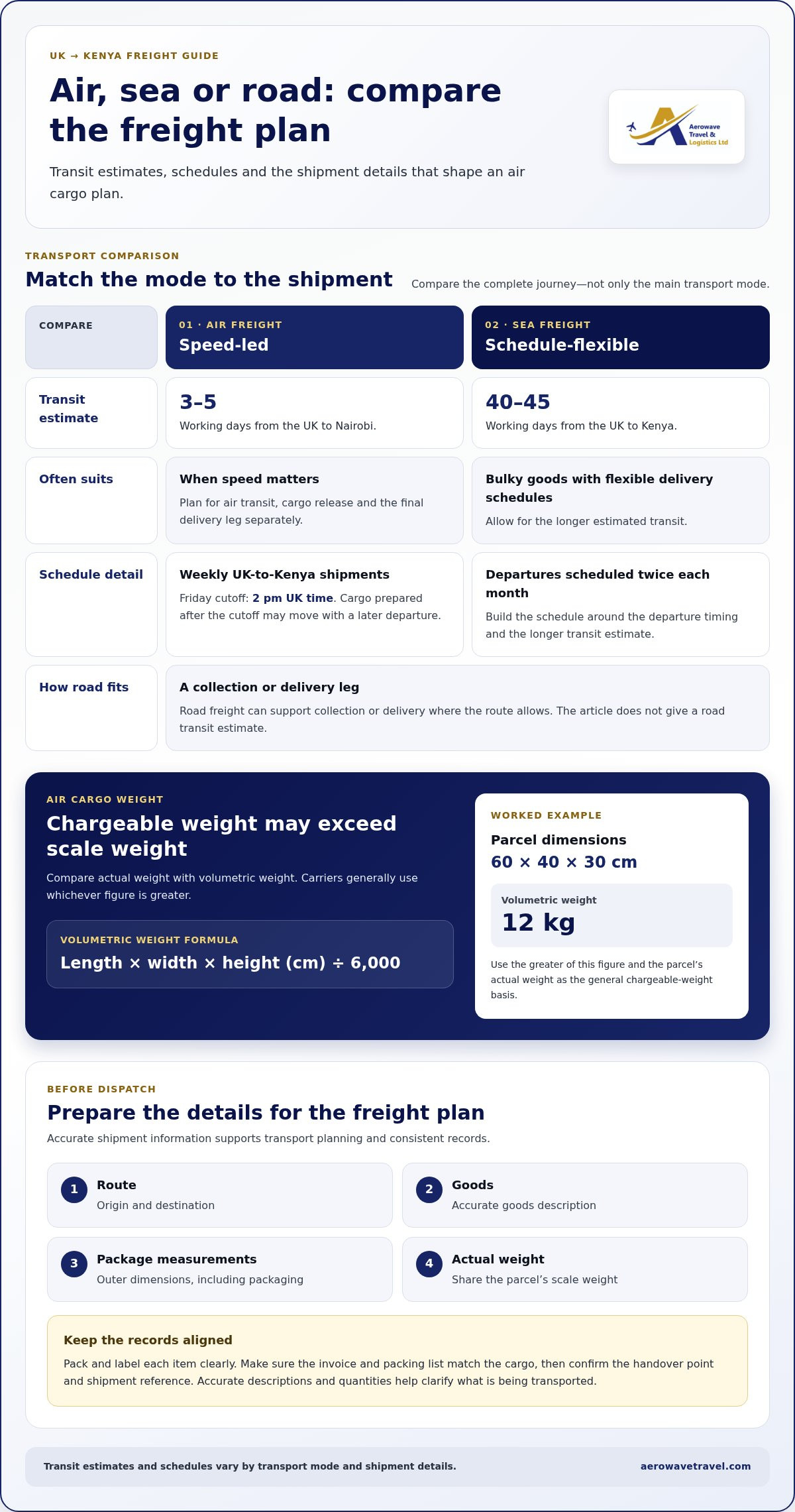
Air freight suits shipments where speed matters, while sea freight can suit bulky goods with flexible delivery schedules. Sea cargo departures from the UK to Kenya are scheduled twice each month, with transit estimated at 40-45 working days. Road freight can support collection or delivery legs where the route allows. Compare the full journey, not only the main transport mode.
Booking and sending cargo
To book cargo to or from Kenya, provide the origin, destination, goods description, package dimensions, and actual weight. The freight team uses these details to plan transport and prepare shipment records. Pack and label each item clearly, then make sure the invoice and packing list match the cargo. Before dispatch, confirm the handover point and shipment reference.
Weight affects how air cargo is assessed. Volumetric weight is calculated by multiplying length, width, and height in centimetres, then dividing by 6,000. For example, a parcel measuring 60 × 40 × 30 centimetres has a volumetric weight of 12 kilograms. Air cargo chargeable weight is generally whichever is greater: actual weight or volumetric weight.
Chargeable weight matters most for light parcels that take up substantial space. A compact, dense package may have a higher actual weight, while a large carton may have a higher volumetric weight. Share accurate outer dimensions, including the packaging, so the freight plan reflects the parcel as handed over. For air cargo services in Kenya, these details help establish the billable shipment weight.
Weekly air cargo shipments from the UK to Kenya have a Friday cutoff at 2 pm UK time. A shipment prepared after that cutoff may need to move with a later departure. Build packing and document preparation into the schedule, rather than treating the cutoff as the time to begin booking. For export cargo from Kenya, the origin handover and required documentation also shape the dispatch plan.
A freight forwarder connects transport arrangements with document handling and customs procedures. This coordination can include organising cargo information, aligning shipment records, and guiding movement between origin, airport, and destination. Customs authorities remain responsible for their own clearance procedures. Clear descriptions and consistent shipment details help everyone work from the same information.
Air, sea, and road can also work as linked transport stages rather than competing choices. For example, road collection can bring cargo to an air terminal, while road delivery can carry it onward after arrival. Match each leg to the shipment’s destination and timing needs. For coordinated air cargo and freight services, use the shipment details to begin planning the route and handover.
Air freight companies operating in Kenya
Kenya’s air freight market includes companies with different roles across a shipment’s journey. Some coordinate freight forwarding, transport, and shipment documents. Others focus on handling cargo or express deliveries. Goodfirms reviewed 28 air freight companies in Kenya as of October 2026. Its category includes a broader selection, so a directory count alone won’t explain which service fits a particular shipment.
The Kenya air freight category includes more than 2,061 air freight companies. That figure describes the category’s breadth, not the suitability of every listing for every route. For a UK-to-Kenya shipment, start by identifying the required route, cargo type, origin handover, and final destination. Those details help clarify whether you need transport coordination, an express option, or cargo export support.
A freight forwarder coordinates transportation, manages documentation, and navigates customs procedures. This links the shipment’s stages, from arranging movement to preparing information for clearance. The airline transports the cargo, while a forwarder can coordinate the journey around that movement. Customs authorities make their own clearance decisions, so coordination does not mean having authority to approve release.
Compare the service scope with the shipment’s practical requirements. For example, a business sending a carton from the UK to Nairobi may need help coordinating collection, air transport, and delivery arrangements. An exporter sending goods from Kenya needs a plan for the origin handover and export documents. A time-sensitive document may be better suited to express mail than standard freight handling.
- Route coordination: Check that the planned origin and destination match the shipment’s needs.
- Cargo handling: Describe the goods and packaging clearly, especially for fragile or bulky items.
- Documentation: Keep shipment records consistent, including item descriptions and quantities.
- Service fit: Match express delivery, general air freight, or export coordination to the shipment’s purpose.
Use these steps to compare service arrangements based on the shipment’s needs. First, note the cargo’s origin, destination, dimensions, weight, and delivery priority. Next, identify the transport and documentation coordination required. Then compare the proposed handling with those needs, including how the shipment moves between handover points. For air cargo services in Kenya, a clear scope makes it easier to understand which tasks are coordinated and which need separate action.
For a UK-to-Kenya route, distinguish the carrier’s air transport from the forwarder’s coordination role. Ask which shipment milestones the arrangement covers, and keep the shipment reference with the invoice and packing details. A straightforward shipment with clear records may need less coordination than cargo requiring several handovers or additional document review. Define the steps early to align the service with the cargo, route, and recipient.
UK-to-Kenya air cargo prices and transit times
Air freight from Kenya is priced by shipment, not at one universal per-kilogram rate. The price depends on the shipment and is provided after a quote request. Chargeable weight, route, parcel dimensions, cargo type, and handling needs affect the calculation.
For UK-to-Kenya shipments, the minimum billable weight for the stated rates is 1 kilogram. This sets the smallest weight used for billing, even when a parcel weighs less. Larger shipments are assessed using chargeable weight, which is generally the greater of actual weight and volumetric weight.
Volumetric weight reflects the space a parcel occupies. Calculate it by multiplying its length, width, and height in centimetres, then dividing by 6,000. A bulky but lightweight box can therefore have a higher billable weight than its scale reading. Measure the outer packaging accurately before estimating freight.
For example, when preparing a large carton, record its packed dimensions and actual weight. The carrier or freight handler can compare those figures to establish chargeable weight. Incorrect dimensions can distort an estimate, so measure the packaging as well as the goods inside.
Air cargo from the UK to Nairobi is estimated to take 3-5 working days. That is an air-transit estimate, not a complete door-to-door schedule. Origin handover, cargo handling, customs processing, and onward delivery can add time. Plan around the shipment’s full route, including its destination beyond the airport.
- Chargeable weight: Compare actual weight with volumetric weight.
- Dimensions: Measure the packed parcel in centimetres.
- Route: Specify the UK origin and Kenyan destination.
- Cargo description: Describe the goods and packing clearly.
- Service scope: Include the required handling and delivery arrangements.
These details help produce a useful quotation because they define what is being moved and how. A compact, dense package and a light, oversized carton can have different chargeable weights. Route and service scope matter too, including whether the shipment needs collection or delivery beyond the airport. Import charges are separate from freight charges and depend on the goods and their assessment.
To prepare a quote request, gather the origin, destination, goods description, packed dimensions, actual weight, and preferred service scope. Make sure the commercial invoice and packing information match the shipment details. These records support transport planning and customs processing, while accurate measurements clarify billable weight before dispatch.
For a UK-to-Kenya shipment, compare the estimated air-transit period with your required arrival date, then allow for handling and clearance. A shipment with complete, consistent details is easier to plan than one requiring corrected measurements or documents. This helps you assess both the per-kilogram calculation and the full journey before sending cargo.
There is no universal per-kilogram rate. The cost depends on the shipment details and is provided after a quote request.
What are the major air cargo airports and cargo terminals in Kenya?
Jomo Kenyatta International Airport (JKIA) in Nairobi and Moi International Airport in Mombasa are major airports for air freight in Kenya. The right arrival point depends on the cargo’s destination and onward journey. A shipment for a Nairobi recipient may use JKIA, while goods intended for coastal delivery may be routed through Mombasa. Include the final delivery location when planning the airport handover.
JKIA has six air cargo terminals. Mitchell Cotts owns one of them. This identifies a facility in Nairobi’s cargo-airport network, but terminal ownership alone does not show which terminal will handle a particular shipment. Cargo handling arrangements and the route determine the relevant handover point. Specify the airport, terminal, and delivery address in the shipment instructions.
For a UK-to-Kenya shipment, confirm whether the planned route arrives at JKIA or Moi International Airport. Then align the recipient’s location and onward transport plan with that airport. For example, a Nairobi-bound consignment and a Mombasa-bound consignment have different final destinations, even when both travel by air. Choosing an airport is one part of coordination, not the complete delivery plan.
At JKIA, the six-terminal figure shows why “Nairobi airport” may not be enough detail for a cargo handover. Shipment documents and handling instructions should identify the consignment clearly. Keep the airway bill reference, cargo description, and recipient information together. These details help the parties coordinating transport link the shipment to its destination and handling arrangements.
Use this sequence when arranging cargo movement through either airport:
- Set the final Kenyan delivery location before selecting the arrival airport.
- Confirm the airport shown in the route and shipment instructions.
- Keep the airway bill reference and cargo description available for handover.
- Plan onward movement from JKIA or Moi International Airport to the recipient.
For shipments using Moi International Airport, apply the same planning principle: match the arrival point with the recipient’s location and onward transport. A Mombasa arrival does not, by itself, set out the final delivery arrangements. Likewise, cargo arriving at JKIA still needs a clear plan from the airport to its destination. Keeping these stages distinct makes the route easier to understand.
Air cargo services in Kenya involve airport selection as well as cargo coordination. For a shipment routed through Nairobi, identify JKIA and the relevant terminal arrangements; for a coastal destination, consider Moi International Airport in Mombasa. Share the complete destination and shipment details when planning, so the airport handover and onward journey fit together. Plan your cargo handover with the route and final destination in view.
Aerowave Air Travel and Logistics Ltd: Air Ticketing Services
Aerowave Air Travel and Logistics Ltd can coordinate travel planning alongside shipment preparation, helping keep business travel arrangements organised. Its Air Ticketing Services and Flight Booking Services support travellers planning a UK or Kenya journey, while airport transfers services from Jomo Kenyatta International Airport help coordinate ground transport around airport travel.
Turn to Aerowave Air Travel and Logistics Ltd when travel arrangements need coordination alongside wider logistics planning. Share your journey requirements to discuss the relevant travel services.
Contact Aerowave Air Travel and Logistics Ltd to discuss your travel arrangements.
Plan Your Next Shipment with Confidence
Before arranging your next shipment, define what a successful delivery needs to achieve. Consider the recipient’s requirements, the goods’ intended use, and how the shipment fits your schedule. This practical brief helps you assess air cargo services in Kenya in light of the shipment’s purpose, not just its transport.
For businesses coordinating cargo alongside travel, Aerowave Air Travel and Logistics Ltd offers Air Ticketing Services, Flight Booking Services, and Airport Transfers Services. These services can help organise related travel plans while your team manages shipment arrangements. Clear priorities make it easier to coordinate air cargo services in Kenya with your business’s wider needs.
Contact Aerowave Air Travel and Logistics Ltd to discuss travel arrangements that support your plans. A considered next step can help you move forward with focus.
Frequently Asked Questions
How Is Your Shipping Weight Calculated?
Billable weight is generally the greater of the parcel’s actual weight and volumetric weight. To calculate volumetric weight, multiply the packed length, width, and height in centimetres, then divide by 6,000. Measure the outside of the packed parcel, not just the item inside. For multiple pieces, record each parcel’s measurements and weight separately so the shipment details reflect the complete consignment.
How Much Does Shipping from the UK to Kenya Cost?
Shipping cost depends on the shipment and is provided after a quote request. The minimum billable weight for the stated UK-to-Kenya rates is 1 kilogram. Chargeable weight, parcel dimensions, route, cargo description, and required handling affect the quote. Freight charges are separate from import duties and taxes, which depend on the goods and their assessment. Share complete measurements and shipment details for a relevant estimate.
What Can You Ship from the UK to Kenya?
Air freight can move parcels and larger consignments, with suitability depending on the goods and their handling needs. Provide a precise description of each item, its quantity, packaging, and intended use. For example, describe a box of replacement components by naming the actual goods rather than using a broad label such as “supplies.” Accurate details support route planning and help determine applicable cargo handling requirements.
What air cargo services are available in Kenya?
Logistics services include air freight coordination, cargo export, express mail delivery, and warehousing and distribution. Choose according to the task: a business exporting goods needs export coordination, while an urgent document may suit an express mail service. Freight forwarding can also coordinate transportation, shipment documentation, and customs procedures. These services support different stages, so identify whether your priority is movement, export, storage, or delivery.
Which airlines and freight forwarders offer air cargo in Kenya?
Airlines operate aircraft, while freight forwarders coordinate cargo movement and related documentation. Kenya Airways, Safari Link, and Renegade Air are listed as local airline partners for domestic routes, which does not establish a specific international cargo route. Aerowave Air Travel and Logistics Ltd coordinates air freight and cargo export services but does not operate its own airline fleet or provide customs brokerage.
What are Kenya’s customs rules, duties, and clearance steps for air cargo?
Customs clearance involves reviewing shipment information and assessing applicable duties and taxes. Prepare an accurate commercial invoice, packing list, goods description, and air waybill details, keeping quantities and descriptions consistent. The assessment depends on shipment-specific information, including the goods and their declared value. A freight forwarder can coordinate documentation and transport, while customs authorities handle assessment and cargo release.
What are typical air cargo transit times to and from Kenya?
Air cargo from the UK to Nairobi is estimated to take 3-5 working days. The full delivery journey also involves origin handling, customs processing, and onward transport. For shipments travelling from Kenya, timing depends on the destination route, handover arrangements, and clearance steps along the way. Include the final delivery point in your schedule, since airport arrival and receipt by the recipient are separate milestones.
What are the size, weight, packaging, and restricted-goods rules for air cargo in Kenya?
Air cargo is generally charged according to whichever is greater: actual or volumetric weight. Pack goods securely, measure the outer parcel, and provide accurate contents and dimensions. The cargo’s nature and packaging affect handling arrangements, while restrictions depend on the goods and applicable carrier requirements. Describe items clearly before dispatch, especially those needing special handling, rather than using broad descriptions that obscure their contents.