A successful Hajj journey is prepared well before departure. For Kenyan Muslims, preparation starts with booking through a properly registered Hajj operator, then arranging travel documents, visa processing and medical certification under the requirements for that season. The Hajj pilgrimage travel requirements from Kenya also include meeting eligibility rules and preparing for the physical demands and conduct expected during the pilgrimage.
It’s understandable to want clear guidance before making travel plans. Requirements can change from year to year, so knowing what to arrange and when can help you prepare with greater confidence.
This guide explains operator booking, documentation and visa processing, eligibility, current requirements, and practical preparation for Hajj. It also outlines the travel-planning support available through Hajj packages, so you can focus on preparing for the pilgrimage while the logistics are coordinated.
Key Takeaways
- Book through a properly registered Hajj operator, and keep written booking terms and payment receipts.
- Prepare your passport, health documentation and visa application early, since requirements apply to each Hajj season.
- Review the current rules for women, minors and permitted travel areas before finalising arrangements.
- Understand that Hajj is obligatory once in a lifetime for Muslims who are able, while personal capacity matters.
- Prepare for demanding days of walking and follow guidance on the rites, travel and conduct during the pilgrimage.
Booking through registered Hajj operators in Kenya
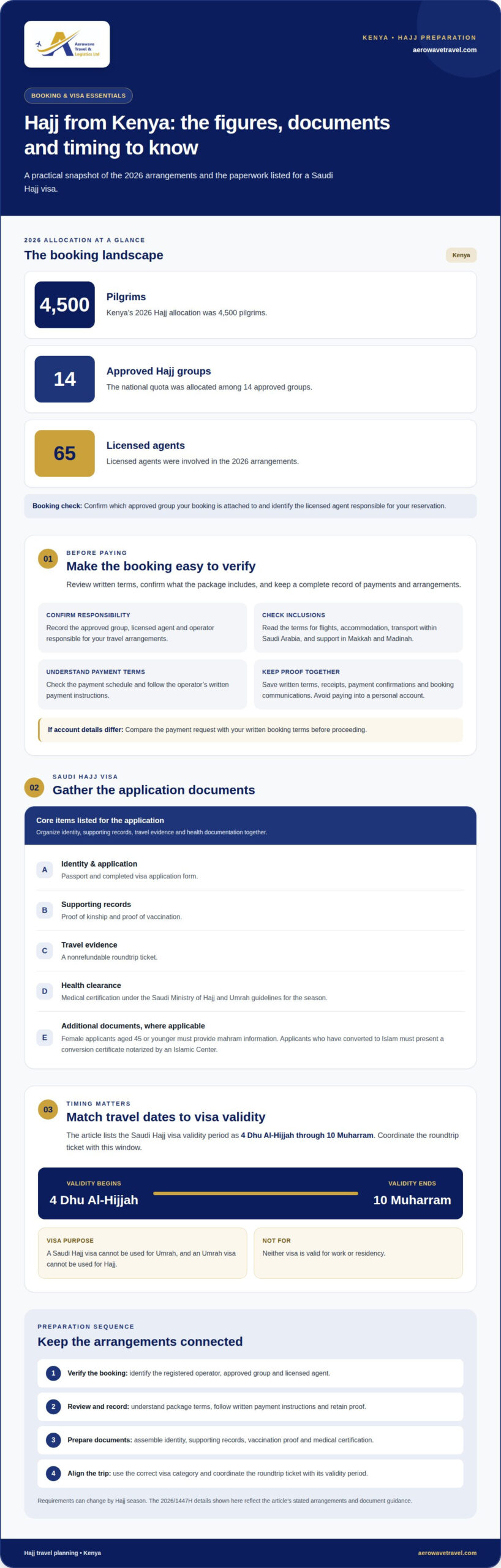
Begin by booking through an operator properly registered in Kenya. The Hajj pilgrimage travel requirements from Kenya start with selecting an approved group and identifying the licensed agent handling your reservation. Kenya’s 2026 Hajj quota was allocated among 14 approved Hajj groups, with 65 licensed agents involved in the arrangements. These figures underline why a booking should clearly show which group and agent are responsible for your travel arrangements.
Before paying, request written booking terms that explain what the package covers. Review the details for flights, accommodation, transport within Saudi Arabia, and logistical support in Makkah and Madinah. Check that the terms name the responsible operator, set out the payment schedule, and explain how you will receive travel documents. Keep a copy of the terms and every receipt as a record for following up on arrangements or payments.
Use a payment method that provides a clear record, and avoid paying into a personal account. Follow the operator’s written payment instructions and keep each confirmation with your booking correspondence. Store these records with your identity documents and travel confirmations. If a payment request names a different account, compare it with the written booking terms before proceeding.
- Identify the group: Establish which approved Hajj group your booking is attached to and which licensed agent handles it.
- Review inclusions: Read the terms for flights, accommodation, Saudi transport and support in Makkah and Madinah.
- Keep records: Save signed terms, receipts, payment confirmations and booking communications together.
- Clarify responsibilities: Note who coordinates each part of the itinerary and communicates updates to the group.
What are common Hajj scams and travel risks for pilgrims booking from Kenya? Unregistered operators can expose pilgrims to financial loss, logistical problems, or denial of entry into Saudi Arabia because of invalid documentation. Written terms, receipts, and avoiding payments into personal accounts can help reduce these risks.
Accredited Hajj agencies coordinate flights, accommodation, transport within Saudi Arabia, and logistical support in Makkah and Madinah. Ask how the itinerary handles travel between locations and how the group will receive practical updates. Hajj pilgrimage travel requirements from Kenya involve more than securing a flight, so understanding who coordinates each arrangement helps you see how the journey fits together.
Make the booking in a clear sequence: identify the registered operator, establish the group and agent responsible, review the written terms, then pay through the stated business channel and retain proof. Kenya’s 2026 allocation was 4,500 pilgrims across 14 approved groups. A booking attached to the appropriate group helps align travel arrangements with the organised Hajj process, while complete records provide a useful reference as preparations continue.
Hajj travel documentation and visa processing
Prepare your passport, health documents and visa application well before departure. Kenyan pilgrims for the 2026/1447H season obtained visas and medical certification in line with Saudi Ministry of Hajj and Umrah guidelines. The requirements connect your identity, health clearance and travel arrangements, so organise the documents together rather than treating the visa as a standalone step.
For a Saudi Hajj visa, the listed application documents include an application form, proof of kinship, proof of vaccination and a nonrefundable roundtrip ticket. Keep each item available for the application process. The ticket must be roundtrip, and the visa is valid only from 4 Dhu Al-Hijjah through 10 Muharram. Its validity window matters when coordinating travel dates.
What vaccinations and health certificates are required for Hajj travelers from Kenya? The required documentation includes proof of vaccination and medical certification. For the 2026/1447H season, Kenyan pilgrims obtained medical certification under Saudi Ministry of Hajj and Umrah guidelines.
Some applications require additional supporting documents based on the pilgrim’s circumstances. Female applicants aged 45 or younger must provide information about a mahram when applying for a Saudi Hajj or Umrah visa. Applicants who have converted to Islam must present a certificate notarized by an Islamic Center attesting to their conversion. Include these documents with the application rather than leaving them until travel preparations are complete.
- Identity and application: Prepare your passport and complete the visa application form.
- Supporting records: Gather proof of kinship and proof of vaccination.
- Travel evidence: Arrange a nonrefundable roundtrip ticket for the application.
- Additional circumstances: Provide mahram information where required, or a notarized conversion certificate if applicable.
- Health clearance: Obtain the medical certification required for the Hajj season.
Match the visa type to the pilgrimage. A Saudi Hajj visa cannot be used for Umrah, and an Umrah visa cannot be used for Hajj. Neither visa is valid for work or residency. Apply for the visa that matches your travel purpose rather than relying on a different category.
Process the paperwork in a coordinated sequence: prepare identity and supporting records, complete the application, arrange vaccination proof and medical certification, then align the roundtrip ticket with the visa’s validity period. Keep copies of submitted documents and issued confirmations together, so the information is accessible during later travel arrangements. For connected travel coordination, keep the flight details aligned with your pilgrimage schedule.
Checking current Hajj requirements
Hajj requirements can change from season to season, so follow the rules for your intended year. Kenyan Muslims are advised to check current requirements with the relevant Kenyan authority. Application steps, health documents, and travel arrangements must align with that season’s instructions.
What are the Hajj application deadlines and payment dates for Kenyan pilgrims? Dates depend on the arrangements for each Hajj season, so there is no single annual deadline or payment date. Plan around the season’s application schedule, document processing, and the payment terms provided for your booking.
For a practical review, compare your circumstances with the rules that affect entry and travel. For example, Saudi requirements include conditions for women and minors, as well as restrictions on where Hajj and Umrah visa holders may travel.
- Women aged 45 or younger: They may not perform Hajj or Umrah in Saudi Arabia without a mahram. Female visa applicants in this age group must provide mahram information.
- Women over age 45: They may travel for Hajj or Umrah in an organized group without a mahram, but must submit a notarized letter of no objection from a male guardian.
- Minors under age 18: They may not travel to Saudi Arabia for Hajj or Umrah unaccompanied by family.
- Visa travel areas: Saudi Hajj and Umrah visas restrict travel to areas in, around and between Makkah, Jeddah and Madinah.
Check how each rule applies before travel documents are prepared. A woman over age 45 travelling in an organized group, for example, needs the notarized no-objection letter. A minor under age 18 needs family accompaniment. These examples affect both the documents to assemble and the travel plan to follow.
Calendar dates also need seasonal attention. Hajj dates depend on moon sighting, and the Islamic calendar shifts the pilgrimage earlier on the Gregorian calendar. The timing of Dhul Hijjah can vary, so check the seasonal calendar before making plans. The dates of the Day of Arafah and Eid al-Adha depend on moon sighting, so treat them as expected rather than fixed. Treat these as expected dates, not fixed annual dates.
Keep requirements aligned with a simple sequence: identify the intended season, review the applicable rules for each traveller, match documents to those rules, then arrange travel around the seasonal calendar. Follow the written booking terms and payment schedule. This approach keeps personal eligibility, visa conditions, and travel dates connected rather than treating them as separate tasks.
Hajj eligibility and obligation
Hajj is the fifth of the five pillars of Islam. Muslims who are able are required to perform it once in a lifetime. Eligibility starts with the religious obligation and the individual’s ability to undertake the pilgrimage. This is separate from completing travel documents: meeting an application requirement does not by itself establish personal readiness.
What rules apply to women, children, and elderly Kenyan Hajj pilgrims? Women aged 45 or younger may not perform Hajj or Umrah in Saudi Arabia without a mahram, while women over age 45 may travel in an organized group without one if they submit a notarized letter of no objection from a male guardian. Minors under age 18 may not travel to Saudi Arabia for Hajj or Umrah unaccompanied by family; for elderly pilgrims, the stated obligation turns on whether they are able.
These conditions affect different parts of preparation. The age rules for women and minors concern travel to Saudi Arabia, while the obligation of Hajj applies to Muslims who are able. A family planning for a minor, for example, needs to account for family accompaniment. A woman over age 45 travelling in an organized group needs the specified guardian letter. Keep these points separate when considering who can travel and who has fulfilled the religious duty.
- First Hajj: For a Muslim who is able, the obligation is once in a lifetime.
- Women aged 45 or younger: A mahram is required for Hajj or Umrah travel in Saudi Arabia.
- Women over age 45: Organized-group travel without a mahram requires a notarized no-objection letter from a male guardian.
- Minors under age 18: Family accompaniment is required for travel to Saudi Arabia for Hajj or Umrah.
- Repeat Hajj: A person wishing to perform Hajj in Saudi Arabia more than once must wait at least five years between pilgrimages.
The repeat-pilgrimage rule is separate from the once-in-a-lifetime obligation. Anyone who has already performed Hajj and is considering another journey should account for the five-year interval. This does not change the stated obligation for a Muslim who is able and has not yet performed Hajj.
Umrah has a different religious status: it is recommended but not compulsory, unlike Hajj. This distinction can help families clarify the purpose of a journey, especially when considering Hajj alongside Umrah. A visa for one pilgrimage cannot replace the visa for the other, so the religious intention and travel arrangements need to match.
For elderly pilgrims, the key eligibility question is ability, not simply family preference or an assumption based on age. Families can discuss the journey together and consider the pilgrim’s circumstances in light of that principle. Hajj is required once in a lifetime for Muslims who are able, and travel conditions for women and minors must also be observed.
Physical demands and conduct during Hajj
Hajj involves sustained movement between ritual sites, and walking distances can reach 5-15 km per day during Hajj. The main rites take place from 8 to 13 Dhul Hijjah and take about five to six days. Plan for consecutive days of activity, rather than treating each rite as a separate, short visit.
The sequence moves through Mina, Arafah, and Muzdalifah, then returns to Mina for further rites. Travel between these locations is part of the pilgrimage, alongside walking within each site. The physical effort comes from both performing the rites and moving with the group through a tightly scheduled itinerary.
- 8 Dhul Hijjah: Pilgrims enter ihram and travel to Mina, where they pray and stay for the day and night.
- 9 Dhul Hijjah: Pilgrims stand at Arafah from midday to sunset, then go to Muzdalifah.
- 10 Dhul Hijjah: Pilgrims stone at Jamarat, sacrifice, shave or trim their hair, then perform Tawaf al-Ifadah and Sa’i.
- 11 to 13 Dhul Hijjah: Pilgrims stone the three pillars at Mina each day and perform farewell Tawaf before leaving Makkah.
This schedule helps explain why pacing matters. Arafah includes an extended period at one location, while 10 Dhul Hijjah brings several rites together. The following days include repeated movement to stone the pillars at Mina. Follow the group itinerary and allow time for transitions between locations, rather than rushing ahead or separating without agreement.
Consideration also helps make the shared journey manageable. Follow group leaders’ instructions during transfers, remain patient when moving with other pilgrims, and make space for anyone who needs assistance. At Mina, Arafah, and Muzdalifah, following the group arrangements helps everyone stay oriented as the schedule changes. Calm communication and consideration matter alongside completing each rite.
Before departure, consider how you will manage several active days and movements between sites. Choose practical footwear and clothing suited to the planned activities, and keep essential personal items accessible during transfers. If you have concerns about managing the walking or schedule, discuss them with a healthcare professional before travelling; individual health circumstances can affect what preparation is appropriate.
Clear travel coordination can make the movements between Makkah, Mina, Arafah and Muzdalifah easier to follow. For support arranging the journey around your pilgrimage itinerary, explore Hajj travel planning.
Aerowave Air Travel and Logistics: Hajj and Umrah Packages
Aerowave Air Travel and Logistics Ltd offers Hajj and Umrah Packages for pilgrims who want their travel arrangements coordinated alongside their preparation. Its support can help you plan a journey from Kenya and coordinate flights and airport transfers with your itinerary.
Flight Booking Services and Air Ticketing Services can support the flight arrangements, while Airport Transfers Services can help coordinate airport transport. This practical assistance lets you focus on pilgrimage preparations. Visa requirements remain subject to the relevant Saudi rules for the season, so align your application and supporting documents with them.
For assistance planning your pilgrimage travel, contact Aerowave Air Travel and Logistics Ltd.
Prepare for your pilgrimage with a clear plan
Use Hajj pilgrimage travel requirements from Kenya as a framework for turning your intention into an organised journey. Bring your travel arrangements together with the preparations you have already made, so flight details and ground transport fit your itinerary. A clear plan can help you focus on the journey’s spiritual purpose.
Aerowave Air Travel and Logistics Ltd offers Air Ticketing Services, Flight Booking Services, and Airport Transfers Services to support these arrangements. These services can help you coordinate travel alongside your pilgrimage preparations.
Contact Aerowave Air Travel and Logistics Ltd to discuss your travel arrangements and take the next step towards a well-prepared Hajj journey.
Frequently Asked Questions
How can Kenyan Muslims prepare for Hajj?
Start by aligning your booking, travel documents, and personal preparations with the requirements for your intended season. Keep application documents, payment receipts, travel confirmations, and messages from your group coordinator together. Plan how you will manage the pilgrimage schedule and communicate with your group during transfers. For example, save the coordinator’s instructions with your itinerary so they are easy to access while travelling.
What should a pilgrim keep in mind?
Keep your pilgrimage purpose, travel documents, and group itinerary aligned. Follow instructions for moving between sites, keep important documents accessible, and communicate with your group if arrangements change. Consider how several active days may affect your personal preparation, especially if you have individual health needs. Discuss relevant health concerns with a healthcare professional before departure, and keep personal essentials easy to reach during transfers.
What are the current Saudi Arabia Hajj visa requirements for Kenyan pilgrims?
For the 2026/1447H season, Kenyan pilgrims obtained visas and medical certification in line with Saudi Ministry of Hajj and Umrah guidelines. The Hajj visa is valid only from 4 Dhu Al-Hijjah through 10 Muharram. It cannot be used for Umrah, work or residency. Requirements can change by season, so prepare for the rules applicable to your intended pilgrimage year rather than relying on an earlier application.
What documents do Kenyan citizens need to apply for a Hajj visa?
The listed application documents include a passport, completed application form, proof of kinship, proof of vaccination and a nonrefundable roundtrip ticket. Some applicants have additional requirements. Female applicants aged 45 or younger must provide mahram information, while converts to Islam must present a conversion certificate notarized by an Islamic Center. Keep copies of submitted documents and confirmations together so you can refer to them during travel preparations.
How do Kenyans register for Hajj and book an approved package?
Book through a properly registered operator and establish which approved Hajj group is handling your booking. Review the written package terms, payment arrangements, and included travel coordination before paying. Keep the signed terms and payment receipts with your records, and avoid paying into a personal account. Make sure your booking documents identify the responsible group and agent, so you know whose instructions apply to your itinerary.
Which Kenyan authorities and licensed Hajj operators manage pilgrimage arrangements?
Kenyan Hajj arrangements involve approved groups and licensed agents, while the Kenya Hajj Mission has communicated season-specific visa information. SUPKEM has also described pilgrim training covering religious rites and practical travel guidance. For 2026, arrangements involved 14 approved Hajj groups and 65 licensed agents. These bodies and operators have different roles, so pilgrims should follow the instructions tied to their registered group and the relevant Kenyan authority.
What are the passport validity, Nusuk, and biometric requirements for Kenyan Hajj pilgrims?
Prepare your passport and follow the documentation process for your Hajj season. Treat passport validity, Nusuk steps, and biometric procedures as separate requirements rather than assuming one replaces another. Follow the applicable instructions within the season’s application process. Keep submission confirmations with your travel papers, and make sure details are consistent across your documents and application records.
What flights and transit routes are available from Kenya to Saudi Arabia for Hajj?
Flight options and transit arrangements depend on the itinerary available for your travel dates and the pilgrimage group’s plans. Do not assume the same route or arrival arrangements apply every season. Coordinate flight details with the group itinerary and onward transport in Saudi Arabia. Air ticketing and flight booking assistance can help arrange commercial travel, while airport transfers can support transport to or from the airport.